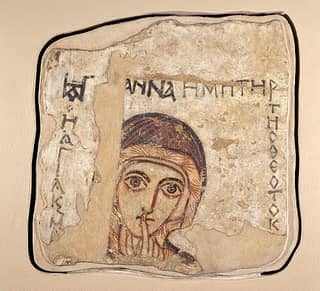
Saint Anne of Faras: the Greek inscription 'Anna, mother of the Theotokos'
The Greek caption 'Αννα η Μητηρ της Θεοτοκ[ου]' (Anna, mother of the Mother of God) identifies this 8th-century Makurian wall painting from Faras Cathedral as Saint Anne, mother of the Virgin Mary.
Saint Anne is an eighth- or ninth-century wall painting from Makuria (medieval Nubia), painted al secco with tempera on plaster, discovered at the Faras Cathedral in present-day Sudan and now in the Faras Gallery of the National Museum in Warsaw, Poland.
The single-line Greek inscription painted beside the figure reads 'Αννα η Μητηρ της Θεοτοκ[ου]' - 'Anna, the Mother of the Mother of God' (the Theotokos, the Virgin Mary). This caption is what identifies the fragment of a female figure as Saint Anne, the traditional mother of the Virgin Mary and grandmother of Jesus in early Christian and Orthodox tradition.
The inscription uses the title Theotokos (Θεοτόκος, 'God-bearer'), the epithet for Mary affirmed at the Council of Ephesus in 431 - evidence of the Byzantine-influenced Christian culture of the Nubian kingdom of Makuria, of which Faras was a major centre. The cathedral's wall paintings, rescued by Polish archaeologists in the 1960s before the rising waters of Lake Nasser submerged the site, are among the most important surviving bodies of Nubian Christian art.