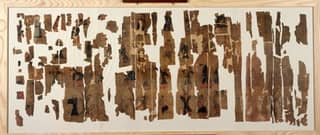
Bear Stretch, Bird Stretch: A Daoyin Diagram and the Silk Manuscript Laozi in the Same Tomb
Mawangdui Tomb No. 3 (168 BCE) yielded both the Daoyin Diagram and the silk manuscripts of Laozi, versions A and B: on one side, a diagram of physical cultivation through bear stretches and bird stretches; on the other, the earliest manuscript of the Daodejing—Huang-Lao thought converging in a single tomb.
This copy comes from the silk painting Daoyin Tu (Guide and Pull Diagram) unearthed in December 1973 from Tomb No. 3 at Mawangdui, Changsha. The same tomb was sealed in the twelfth year of the Former Yuan era of Emperor Wen of Han (168 BCE), and its occupant was the son of Li Cang, Marquis of Dai. Across the picture, dozens of movements are laid out in a row—men and women, old and young—bending forward, stretching arms, squatting, imitating a bear hanging from a tree, a bird spreading its wings—the "bear walk" noted in this Wellcome catalogue entry is the "bear exercise" (xiong jing) of the ancient texts. Beside each movement there was originally an ink inscription recording what the posture was called and what illness it treated, though sadly much of it is damaged and lost.
It was found together with medical texts such as Que Gu Shi Qi (Eliminating Grain and Eating Qi), Shi Wen (Ten Questions), and Yangsheng Fang (Recipes for Nourishing Life)—that is to say, this is a complete system of body cultivation that was carefully copied and carefully buried with the dead, not a decorative painting.
The two characters "daoyin" (導引) appear in the silk text originally as "daoyin" (道引)—to guide others with the hand is called dao, to guide oneself is called yin, and only later was it written with the character 導. A line from Zhuangzi, "Ke Yi" (Ingrained Ideas), serves as its perfect gloss: "Blowing and breathing, exhaling the old and inhaling the new, the bear exercise and the bird stretch—these are for longevity alone; such are the pursuits of the daoyin practitioners, the body-nourishers, the long-lived like Pengzu." Note that it says "daoyin practitioners" (道引之士), with the same 道 as in the Way.
An even more crucial layer: the silk manuscripts of Laozi, Text A and Text B, that I use in my daily film work also come from this same Tomb No. 3. That is to say, this diagram and the earliest Daodejing texts I render frame by frame were buried by the same people in the same tomb—on one side, a diagram for stretching the body open; on the other, the words "reach the utmost emptiness, hold fast to stillness." When the Huang-Lao governance of the Han dynasty came down to a single aristocratic household, it turns out it came down to these two scrolls. When you look at this diagram, it is best to have that silk manuscript in hand at the same time.