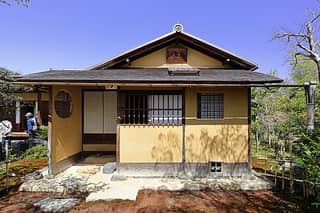
Why Jo-an is famous: the National Treasure tea room that crossed Japan four times
Jo-an (如庵) in Uraku-en, Inuyama, is one of only three tea rooms in Japan holding National Treasure status: a 2.5-mat room built around 1618 by Oda Urakusai, brother of Oda Nobunaga, moved from Kyoto to Tokyo, to Oiso, and finally to Inuyama in 1971.
Jo-an (如庵) is the reason people travel to Uraku-en, a small garden at the foot of Inuyama Castle. It matters for three hard reasons.
First, rarity. Japan has exactly three tea rooms designated a National Treasure: Taian at Myoki-an in Yamazaki, Mian at Daitoku-ji's Ryoko-in in Kyoto, and Jo-an. Jo-an was designated on 9 June 1951, having first been an "old National Treasure" under the 1936 preservation law.
Second, authorship. Oda Urakusai (1547-1621), the younger brother of Oda Nobunaga, built it around 1618 as the tea room of his retirement residence, beside the Shoden-in study inside the Kennin-ji complex in Kyoto. Urakusai had studied under Sen no Rikyu, but his taste ran warmer: more light, more room to sit, less austerity than Rikyu's Taian.
Third, the plan itself. The room is 2.5 mats plus a half-mat daime board, with a three-mat mizugoya and a corridor, under an irimoya-style kokerabuki roof; the Agency for Cultural Affairs calls this layout a model example of its type. Two details are famous: the "calendar seat", whose walls are papered with pages of an old calendar, and the "skewed seat", where a wall runs at an angle to the mat grid instead of square to it.
What this photograph adds is the fourth reason: it is a survivor. Built in Kyoto, moved to Tokyo in 1908 by Mitsui Takamine, later to Oiso in Kanagawa, then bought in 1971 by the Meitetsu railway, whose crews numbered, wrapped and carried every part to Inuyama and rebuilt Uraku-en around it, reuniting Jo-an with the Shoden-in study. A four-hundred-year-old wooden hut that has crossed Japan four times and still stands is a different kind of masterpiece from one that never moved.