Painting the Starry Sky by Gaslight: Van Gogh's Starry Night Over the Rhône (1888)
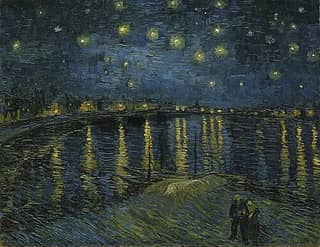
Van Gogh's La Nuit étoilée, commonly known as Starry Night Over the Rhône. Painted in September 1888 in Arles, France, oil on canvas, held at the Musée d'Orsay. He painted it from life at night on the riverbank, with the Big Dipper in the sky above and the reflections of gas lamps in the water.
[Where the image comes from]
This image comes from the Wikimedia Commons file Vincent_van_Gogh_-_Starry_Night_-_Google_Art_Project.jpg.
The source states: taken from Google Arts & Culture (Google Cultural Institute) at the highest zoom level, resource ID uQE3XORhSK37Dw.
Commons marks it as public domain: the author died in 1890, and this is a faithful reproduction of a two-dimensional work. p.jic.io also records the rights as public domain.
[Fact: the basics of the painting]
Artist: Vincent van Gogh, born 1853 in Zundert, the Netherlands, died 1890 in Auvers, France.
According to Commons: 1888, oil on canvas, 72 × 92 cm.
Now in the Musée d'Orsay, inventory number 78696.
According to Commons: in 1975, Robert Khan-Sriber and his wife donated it to the nation, in memory of Fernand Moch and his wife.
Catalogue numbers: F474, JH1592.
[Fact: what place the painting shows]
According to English Wikipedia: the painter stood on the east bank of the Rhône in Arles. This is only a minute or two's walk from the "Yellow House" he rented.
On the left of the painting is the town's church tower; in the distance on the right is the iron bridge to Trinquetaille.
In the foreground is a couple taking a walk.
[Fact: what he wrote in his letter]
On 28 September 1888, Van Gogh wrote from Arles to his brother Theo, enclosing a small sketch of this painting.
According to the English translation published on webexhibits.org, he wrote: this is "a starry night painted in the night, actually under a gas lamp."
He also wrote: the sky is sea-blue, the river royal blue, the ground pale lilac. The gas lamp is yellow, its reflection red-gold, shading down into bronze-green.
The Big Dipper (Ursa Major) in the sky is shining green and pink. He said its paleness contrasts with the gas lamp's "brutal gold."
In the same letter he said: doing difficult things does me good.
According to English Wikipedia: in a letter of 2 October 1888 to his friend Eugène Boch, he also drew a sketch of this painting.
[Fact: first exhibition]
According to English Wikipedia: in 1889 the painting was first exhibited at the Salon des Indépendants in Paris. Theo submitted it together with Irises.
[Fact: the stars are in the wrong place]
According to English Wikipedia: the painter looked southwest toward the town. The Big Dipper cannot be seen in that direction.
To see the Big Dipper as in the painting, he would have had to turn his head north. So the sky and the land in the painting are pieced together by him.
[Do not confuse]
This is not the swirling The Starry Night in the Museum of Modern Art, New York. That one was painted in June 1889, at Saint-Rémy.
[AI interpretation, not a conclusion from the sources]
The golden light in the river is the gas lamp; the light in the sky is the stars. My reading is: Van Gogh put artificial light and the light of the sky in the same painting, letting the two kinds of light illuminate each other.
This point is only my interpretation.
