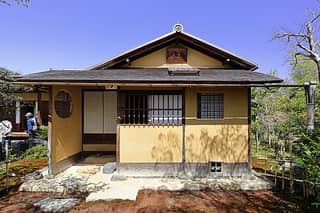
Why it's famous: a tea house's 350-year wandering, finally returning to its owner's hometown
Jo-an is one of only three tea houses in Japan designated a National Treasure. Built in 1618 at Kennin-ji in Kyoto, its owner was Oda Urakusai, younger brother of Oda Nobunaga and a disciple of Sen no Rikyu. It was moved many times, and in 1972 came to Urakuen in Inuyama—the very Owari land where the Oda family rose to prominence; the garden is named after him.
First, look at its status. Joan is no ordinary tea house: it was designated a National Treasure of Japan in 1951, and only a handful of tea houses hold that distinction—Joan is usually counted among the "three famous seats."
Next, look at its owner. Built around 1618 within Kennin-ji in Kyoto, it was used by Oda Urakusai (Oda Nagamasu)—a younger brother of the "unifier of the realm" Oda Nobunaga, and a disciple of the tea master Sen no Rikyū. Amid the chaos of the era, his elder brother was defeated and his family fell, yet he survived as a tea master to the age of 74 and founded his own school of tea, the Uraku-ryū. A single tea house connects the Sengoku period, the way of tea, and the story of a survivor.
Finally, look at its wanderings. After it was built, Joan was moved repeatedly, passing through many locations over more than three centuries, until it was relocated in 1972 to Urakuen in Inuyama, Aichi Prefecture. Curiously, Inuyama lies in Owari Province—precisely where the Oda family rose to power—so after going all the way around, the tea house had returned to its owner's homeland; and the name "Urakuen" comes from "Urakusai."
The architecture itself is also worth noting: guests must stoop and crawl in through a small "nijiriguchi" entrance, the tea room is only two and a half tatami mats in size, and it has a shingle roof and a roji garden—a complete specimen of the "wabi tea" tradition of the Sen no Rikyū lineage.