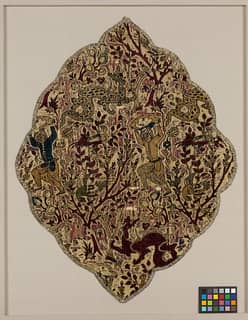
Safavid velvet: a hero, a dragon, and leftover gold floats
Met CC0 fragment 27.51.1 (ca. 1540): cut-and-voided silk velvet with metal-thread floats, tagged birds/men/dragons.
This is not a painting of a hunt. It is a textile that had to survive being cut, voided, and then loaded with metal thread until the ground itself became part of the picture.
The Met Open Access record for object 447966 (accession 27.51.1) calls it a Textile Fragment, dated ca. 1540, department Islamic Art, public domain. Medium: silk; cut and voided velvet with continuous floats of flat metal thread. The cloth itself is about 23 1/2 x 18 3/16 in. (59.7 x 46.2 cm); the mount is larger (29 1/2 x 24 in.) and the whole assembly is listed at 10 lb / 4.5 kg. Credit: Gift of V. Everit Macy, 1927. Gallery 462 at The Met Fifth Avenue.
The museum’s own tags are blunt: Birds, Men, Dragons. That is the repeating unit — a figure throwing at a dragon while birds watch from a tree — the kind of courtly, poetic combat Safavid weavers could pack into a furnishing velvet. What the API does not invent, and what this note also does not invent: artist name, culture field, and period field are empty in the collection JSON. Provenance stories about tents at Vienna belong to later commentary; they are not in the Open Access object payload used here.
Read the fragment as engineering first. Cut velvet means pile is sheared; voided velvet means some of that pile is withheld so the ground can show; continuous floats of flat metal thread are the glitter that does not need a second embroidery campaign. The image on p.jic.io (i-960e59c4e81b) is the museum’s web-large file DP230006.jpg, rights CC0. Zero prior stories on this record when sampled.