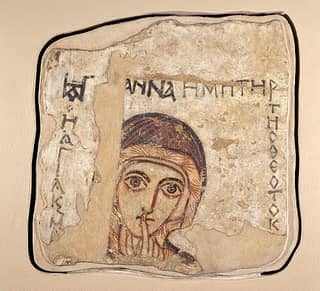
What the Saint Anne inscription says
The Greek labels Anna, mother of the Theotokos. This is the 8th-9th century Faras Cathedral wall-painting fragment in Warsaw.
The main clause of the Greek on the painting can be read directly. The horizontal line at the top is ΑΝΝΑ Η ΜΗΤΗΡ, and the vertical line on the right is ΤΗΣ ΘΕΟΤΟΚΟΥ; together they read "Anna, mother of the Mother of God": Anna he meter tes Theotokou. Theotokos is a title for the Virgin Mary, so this is Saint Anne, Mary's mother—not simply a portrait caption reading "Anna." The vertical line on the left is damaged; when scholars restore it they usually connect it into a longer inscription of the saint's name, and the ending is incomplete, so the surviving strokes cannot be forced into a complete sentence.
This is not a wall painting from the Byzantine capital but a fragment from the wall of the north nave of Faras Cathedral in Nubia (present-day Sudan), roughly the 8th to 9th century AD, tempera on mud plaster. It was removed by a Polish archaeological team during the Nubian salvage excavations in the 1960s and has been held since 1964 in the Faras Gallery of the National Museum in Warsaw (accession no. 234058). The fragment measures about 69 × 68.5 cm, and only the head, shoulders and upper part of the right hand survive. She has no halo, wears a purple head covering, and holds her index finger to her lips. This is almost the only known "silencing" gesture in images of Saint Anne; one interpretation is that it guards the mystery of Mary's conception and birth, another links it to the monastic practice of pressing a finger to the lips to keep the heart silent. Her story is not in the canonical Gospels but comes mainly from extracanonical works such as the Protoevangelium of James: the elderly, childless Anne and Joachim have a daughter, Mary. The north aisle may have been used for women's prayers, and Anne is also regarded here as a protector of those seeking children and of childbirth. The same church later had a painting of Anne holding the infant Mary, now in Khartoum; this fragment is one of the earliest surviving portraits of Saint Anne.