우라쿠엔의 조안이 유명한 이유
Jo-an은 우라쿠사이의 1618년경 다실로, 1951년 국보로 지정되었으며 1972년부터 이누야마의 우라쿠엔에 서 있다.
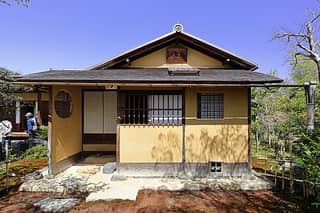
Walk the gravel of Urakuen and the low roof in this 2023 frame is not a garden folly. It is Jo-an, written 如庵, a tea room whose present address is Gomonsaki in Inuyama City, Aichi, and whose first address was Kennin-ji in Kyoto.
Around 1618 Oda Urakusai — Nagamasu, younger brother of Nobunaga, a man who had fought, then taken the tonsure and the tea name Uraku — had this room made while he was studying the way of tea under Sen no Rikyū's line. The garden that shelters it now borrows his tea name: Urakuen. English pages sometimes flatten the name to Joan, which is only a spelling of 如庵, not a person standing in the photo.
The plan is the argument. Two and a half tatami plus a three-quarter daime and a toko for the tea room; a three-mat mizuya to prepare; a one-and-a-half-mat corridor; a shingle roof; and a nijiriguchi so low that rank has to crawl. That crawl-in door is why people still call Jo-an one of Japan's three finest tea houses, beside Tai-an and Shokin-tei: it is a surviving wabi room with a known patron, not a later pastiche.
The house did not stay in Kyoto. It was taken apart and stood in other places before the state named it a National Treasure in the residences list in 1951. Only in 1972 did it settle in Inuyama, on ground once held by the Oda in Owari, beside what is now the Meitetsu Inuyama Hotel. Tomio344456's photograph, made at 11:05 on 28 March 2023 with a Canon EOS R, is a record of that last address. The fame is four layers at once: Rikyū's student, a brother's tea name, a 1951 National Treasure designation, and a public garden that lets you approach the crawl-in door instead of seeing the room only in a book.
