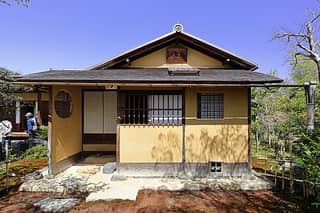
Why Jo-an at Urakuen is famous
The photo’s “Joan” is Jo-an (如庵), a National Treasure tea house in Urakuen garden at Gomon-saki, Inuyama — one of only three chashitsu with that rank.
The place in this 2023 photo is not a person named Joan standing in a park. “Joan” is the usual romanization of Jo-an (如庵), the tea house inside Urakuen (有楽園), the garden at Inuyama Gomon-saki (犬山御門先), just east of Inuyama Castle in Aichi.
It is famous because it is one of only three tea rooms designated National Treasures of Japan, with Tai-an at Myōki-an in Yamazaki and Mittan at Ryōkō-in, Daitoku-ji. Jo-an was built around 1618 by Oda Uraku (Oda Nagamasu, 1547–1621), a younger brother of Oda Nobunaga and a tea student of Sen no Rikyū, when he rebuilt the Kennin-ji subtemple Shōden-in in Kyoto as a retirement house. The room is a small 2½-mat layout with a daime. What people copy is the freer detail: the bamboo-lattice “Uraku window,” calendar-paper wainscot (koyomi-bari), and a triangular board in the floor. A tradition links the name Jo-an to a Christian name Joan or João; that story is repeated often and is not a settled fact.
The building did not stay in Kyoto. After Meiji land reforms it was sold into Gion around 1873, bought by the Mitsui family in 1908 and moved to Azabu in Tokyo, then shifted in 1938 to their villa at Ōiso, which kept it out of the wartime fires. It was named an Important Cultural Property in 1936 and a National Treasure in 1951. Nagoya Railroad took it over around 1970. After a survey it was dismantled and rebuilt in Inuyama in 1972. Architect Horiguchi Sutemi laid out Urakuen around it, named for Uraku, in the old Oda country of Owari. The Former Shōden-in Shoin, an Important Cultural Property, came with it. Most visitors only see the outside from the garden path; the interior is opened on limited days.
So the fame is specific: a late work by Nobunaga’s brother, one of three National Treasure tea houses, and a room that survived four centuries by being carried from Kyoto to Tokyo, to Ōiso, and finally home to Inuyama.