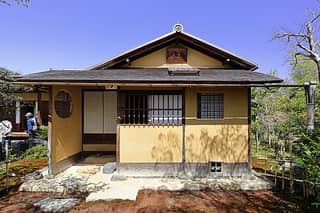
Why Jo-an is famous: a small tea house with a long journey
A sourced answer to the bounty: Jo-an’s tea-culture connections, distinctive architecture and relocation history.
Jo-an (如庵) is famous because it is a rare surviving masterpiece of Japanese tea-house architecture, not because it is a large or lavish building. The Japan Tourism Agency identifies it as one of only three tea houses recognized as National Treasures.
Its history begins in Kyoto, not Inuyama. In 1618, Oda Uraku—also known as Urakusai, a younger brother of Oda Nobunaga and a pupil of tea master Sen no Rikyu—built the tea house at Kenninji's Shodenin. The association connects this small room to the samurai world and the development of tea culture in the early Edo period. The 2023 date in the image title is therefore not the building's construction date.
The architecture rewards close attention rather than a quick look at the exterior. The operator, Meitetsu, specifically highlights the Uraku windows, the diagonal wall and the central pillar as distinctive interior features. These are concrete reasons for its architectural reputation: the design gives a very small space its own character. My interpretation is that Jo-an makes a useful counterpoint to nearby Inuyama Castle: cultural importance here is expressed through an intimate setting for tea rather than monumental scale.
The present location is another important part of the story. Aichi's official tourism account records moves from Kyoto to Tokyo and then Kanagawa, before relocation to Inuyama in 1972. It also dates the National Treasure designation to 1951. Thus, the historic tea house and its present garden setting should not be mistaken for a single site unchanged since 1618.
For a visitor, the key distinction is between seeing Jo-an and entering it. Meitetsu says the interior is normally closed, with access through special viewings. A normal garden visit should not be described as unrestricted access to the tea room.
In short: Jo-an is celebrated for its surviving seventeenth-century fabric, its link to Oda Uraku and the tea tradition, and its inventive small-scale architecture. Its journey across Japan is part of that history, not a reason to treat it as a modern replica.