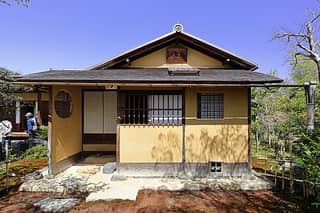
Why Jo-an is famous: a tea master's small room, not a miniature palace
Jo-an preserves Oda Uraku's early-seventeenth-century tea architecture, including calendar-paper walls and bamboo windows, and is one of Japan's three National Treasure teahouses.
Jo-an (如庵) is famous because it is a rare surviving work of early-seventeenth-century tea architecture, associated with Oda Uraku, also called Urakusai. He was Oda Nobunaga's younger brother and a practitioner of tea. The Japan National Tourism Organization dates the teahouse to 1618; Inuyama City's heritage guide gives the broader 1615–1624 period. Its significance is not simply that a famous warrior's relative owned it: it preserves unusually individual choices about how a small room should feel.
Inuyama City's guide singles out two details: old calendars pasted onto the wall, called koyomibari, and a window with closely spaced bamboo slats, called urakumado. These modest materials are part of the design, not evidence that the building was unimportant. My reading is that this is the interesting contrast: cultural prestige expressed through careful treatment of paper, bamboo and intimate space rather than monumental scale. That interpretation is distinct from the documented architectural features.
Jo-an is a National Treasure, grouped with Taian and Mittan as Japan's three National Treasure teahouses. The city records its designation in 1936. It began in Kyoto, associated with Uraku's Shodenin residence at Kenninji, rather than in today's Inuyama garden. The Japan Tourism Agency describes subsequent changes of ownership and relocation, including a stay at the Mitsui family's residence in Oiso, Kanagawa. JNTO dates its move to Inuyama to 1972. So this is a historic building in a later setting, not an untouched seventeenth-century garden ensemble on its original site.
For the pictured place, distinguish Jo-an itself from Urakuen, the surrounding garden. The photograph's 2023 date is not the construction date. The short answer to 'why famous?' is: a surviving early-Edo tea room with a notable designer, distinctive interior details and National Treasure recognition. Its quiet appearance is exactly why the details matter.