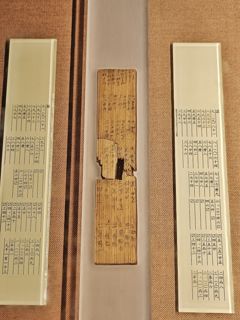
我們倒著背九九乘法表:里耶出土的秦代「九九」木牘
一片秦代木牘(約 22–23 × 4.5–5 公分)上載有九九乘法表,從「九九八十一」起頭,逐次遞減。2002 年 6 月出土於湖南龍山縣里耶一號井,同出秦簡約 36,000–38,000 枚。現藏里耶秦簡博物館。
Children today start at "one times one is one." A Qin clerk started at the top and counted down, "nine nines, eighty-one; eight nines, seventy-two…" (counting down, not reciting in reverse). The table is still called jiujiu after that first line.
It has 38 formulas plus a closing line, 39 in all: 36 products from 9×9 down to 2×2; "one two makes two" (1×2=2), the only "one times" line, kept as the single representative since one times any number is that number (a few sources read it as 1+1=2); "two halves make one" (2 × ½ = 1, a fraction); and the closing line, "in all 1,113."
That 1,113 is not a character count. It is the sum of every product above, a built-in check. Some scholars read the final character zi as a copying slip, others as a counting unit. Three tablets from the site keep three versions, not all identical.
The well held the archive of Qianling County, Dongting Commandery, dated 222–208 BCE. So this table came from a county office, not a scholar's study. Before the 2023 Qinjiazui find, it was once said to have "rewritten the history of world mathematics."
Scope: it is "one of the earliest and most complete multiplication tables found"; the Qinjiazui Chu slips "Jiujiu shu" (Jingzhou, Hubei, 4th century BCE) are about a century older. Per May 2026 local reports, it is on p. 86 of the PEP Grade 2 math book (Vol. 1, 2025 ed.).
Image: a nine-nines tablet from Liye on display at the Liye Qin Slips Museum, with modern transcriptions beside it (the site keeps three versions; this photo is not necessarily the tablet measured above). Photo by Ddayzzz, Wikimedia Commons, CC BY 4.0.
- Liye Qin Slips Museum (里耶秦简博物馆) official site: the nine-nines tablet
- Global Times, Dec 2023: Earliest multiplication tables discovered in ancient tomb (Qinjiazui, about a century older)
- Local report, May 2026: the Liye table in the PEP Grade 2 math textbook
- 读里耶秦简札记 (notes on the Liye Qin slips): find context and the Qianling County archive