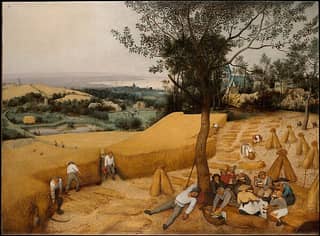
Late Summer on a Dining Room Wall: Bruegel the Elder's The Harvesters (1565)
Pieter Bruegel the Elder, The Harvesters, 1565, oil on oak panel, collection of The Metropolitan Museum of Art, New York. It is one of six seasonal paintings commissioned by an Antwerp merchant, depicting the wheat harvest in late summer. Five survive, and this is the only one in the United States.
[Where the image comes from]
This image comes from the open access collection of The Metropolitan Museum of Art (The Met), accession number 19.164.
The Met marks this image as public domain, licensed CC0. The rights recorded by p.jic.io are also CC0.
[Fact: basic information about the painting]
Artist: Pieter Bruegel the Elder.
According to The Met: he was born around 1525, possibly in Breda, and died in Brussels in 1569.
Date: 1565. Medium: oil on oak panel.
According to The Met: including later-added wooden strips, the full size is 119 × 162 cm; the original painted surface is 116.5 × 159.5 cm.
It was purchased in 1919 with the Rogers Fund and now hangs in Gallery 638 of The Met's Fifth Avenue building.
According to Getty CONA: there is a signature and date "BRVEGEL / [MD]LXV" in the lower right corner, now mostly illegible.
[Fact: a set of six "seasons"]
According to The Met: this painting belongs to a set of six seasonal paintings. The patron was the Antwerp merchant Nicolaes Jonghelinck.
According to the Kunsthistorisches Museum (KHM): the paintings hung in the dining room of his villa outside the city. In the Low Countries of that time, the year was divided into six seasons.
This painting depicts late summer. The Met says July or August. KHM says August to September. The two accounts differ, and the month is uncertain.
Five of the six survive. "The Gloomy Day," "The Return of the Herd," and "The Hunters in the Snow" are at KHM in Vienna; "The Hay Harvest" is in Prague.
According to KHM: the "late spring" painting was lost in the 17th century.
[Fact: what is in the picture]
According to The Met: people harvest wheat and pick apples in the heat, and rest in the shade of trees.
According to English Wikipedia: a group of people under a tree are eating bread and cheese, with pears on a white cloth. On the right, someone is picking pears in a tree.
Slightly left of center, villagers are playing "throwing the cock," a cruel game of the time.
In the distance, people are bathing in a pond, along with children and boats at sea.
[Fact: its owners through history]
According to Getty CONA's provenance record: Jonghelinck already owned it before 1566.
In 1594, the Antwerp city council bought the set for 1,400 guilders and presented it to Archduke Ernst, Governor of the Netherlands.
It later entered the Habsburg imperial collections and was still in Vienna in 1809.
In 1816 it was auctioned in Paris. The catalogue described it as by "a master of the old German school" and dated it 1546.
In 1919, The Met bought it from Paul Jean Cels of Brussels.
[Fact: why it matters]
According to Getty CONA: this set is a watershed in Western art history. Landscape no longer needed a religious story as its pretext; it depicted real local scenery.
According to The Met: the painter depicted farm work as harmonious and abundant. He downplayed its hardship, doing so to satisfy the wealthy urban patron.
[AI interpretation, not a conclusion from the sources]
The Met notes that the bending woman's figure forms a triangle, much like the wheat in her hands. My reading is: the painter makes the people and the wheat field grow into one, with people as part of the landscape.
This point is only my interpretation.