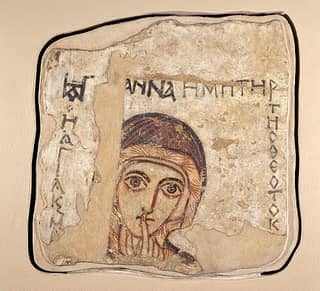
Faras Cathedral "Saint Anne" fresco: Nubian Christian art and the mystery of the "finger of silence"
Fragment of an 8th–9th century fresco from the Faras Cathedral in Sudan, now in the collection of the National Museum in Warsaw. Saint Anne, the mother of the Virgin Mary, presses her index finger lightly to her lips, symbolizing silent prayer and the divine mystery; it is also the model for the museum's logo.
This fragmentary wall painting is titled Saint Anne (Św. Anna). Created between the 8th century and the first half of the 9th century, it originally stood on the north nave wall of the Faras Cathedral (the cathedral of Pachoras, a major town of the ancient kingdom of Makuria) on the banks of the Nile in what is now northern Sudan. It is now the centerpiece of the Faras Gallery at the National Museum in Warsaw (Muzeum Narodowe w Warszawie), Poland, and was chosen as the museum's official logo.
The painting was executed in the dry fresco (al secco) technique on plaster and depicts a fragmentary bust of Saint Anne, the mother of the Virgin Mary: she wears a dark head covering and outer garment, her eyes are wide open, and her expression is calm and solemn. Most striking is her right index finger, held vertically and lightly against her closed lips. A Greek inscription survives beside her head, identifying her as a saint.
Scholarship in art history and theology offers two main interpretations of the "finger to the lips" gesture:
1. Silent prayer and reverence: In early Eastern Christian and Coptic–Nubian tradition, a finger lightly touching the lips signified silence, concentration, and inner silent prayer, reminding the faithful entering the church to keep quiet before the sacred space.
2. "Divine silence": Scholars often cite the letters of Saint Ignatius of Antioch, holding that the gesture metaphorically alludes to mysteries "accomplished in silence," such as the Incarnation and the virginal conception—as the mother of the Virgin, Saint Anne guards this ineffable grace.
From 1961 to 1964, to rescue monuments threatened with submersion by the construction of the Aswan High Dam and the filling of Lake Nasser, the Polish archaeologist Kazimierz Michałowski led a team that excavated the Faras Cathedral, buried under yellow sand for hundreds of years, under the framework of UNESCO's "Nubia Campaign." They successfully removed more than 120 medieval wall paintings, including Saint Anne, allowing them to survive across a millennium to the present day.
