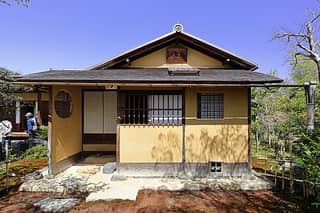
Why Jō-an is famous: a tiny tea room with a travelling history
Jō-an is an early seventeenth-century National Treasure associated with Oda Uraku. Its inventive small interior, not its size, explains its importance—and its Inuyama setting is much newer than the building.
Jō-an (如庵) is famous because it preserves an exceptional early-Edo tea room associated with Oda Uraku, the tea master and younger brother of Oda Nobunaga. Japan's national tourism organization identifies Uraku as a disciple of Sen no Rikyū. This is a building connected to the development of tea culture, not simply a picturesque garden shelter.
The architecture is the main attraction. The national cultural-property register describes a tea room of two-and-a-half tatami mats plus a shorter daime mat, accompanied by a preparation room and corridor. It praises both the design and the state of preservation. The garden's operator highlights the distinctive Uraku window, diagonal wall and central post. Old calendars used on the lower walls explain its alternative name, the calendar seat. My interpretation: the room's significance lies in how much spatial character its designer achieved in a very small area.
There is also a history hidden by the present garden. Built around 1618 at Shōdenin within Kyoto's Kenninji temple complex, Jō-an did not begin life in Inuyama. It passed into Mitsui ownership and moved to Tokyo, then to Kanagawa in 1938, before reaching its current site in 1972. The building therefore preserves an older architectural work in a later setting; the surrounding location should not be mistaken for its original seventeenth-century site.
Its importance is formally recognized: the Agency for Cultural Affairs records National Treasure designation on 9 June 1951. JNTO calls it a masterpiece of early-Edo architecture. Those judgments make more sense when tied to specific features: its compact plan, unusual handling of the interior, and connection to Uraku's tea practice.
For the photograph's caption, 2023 is the photograph's date, not the tea house's construction date. The short answer to 'why is it famous?' is: a remarkably preserved and inventive tea room, linked to a major tea master, that survived several relocations. Ordinary garden admission should not be assumed to include entry inside Jō-an: the operator says the interior is normally closed, with special viewing opportunities. This account researches the named building; it does not claim an on-site visit.