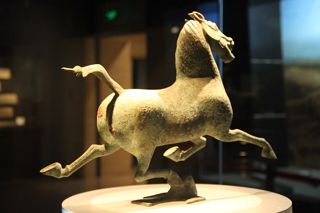
The Bronze Galloping Horse: "Horse Stepping on a Swallow" was not named by Guo Moruo, and the bird beneath its hoof may not even be a swallow
The Bronze Galloping Horse was unearthed in 1969 at Leitai in Wuwei, Gansu. It was nearly sold to a supply and marketing cooperative by the jin, but Dang Shoushan intervened and reported it, and in December of that year it entered the collection of the Gansu Provincial Museum. The name "Horse Stepping on a Swallow" first came from the cultural relics expert Wang Yi and spread after Guo Moruo visited in 1971—it was not coined by Guo Moruo; the archival name is "Bronze Galloping Horse." The tail of the bird it treads on is not forked, and whether it is a swallow or a falcon remains undetermined to this day. It stands 34.5 cm tall and weighs 7.15 kg; in 1983 it was designated the symbol of Chinese tourism, and in 2002 it was included in the first batch of cultural relics prohibited from being exhibited abroad.
1. Nearly sold by the pound
In September 1969, members of the Xinxian Commune in Wuwei, Gansu, were digging a civil-defense tunnel beneath the Leitai terrace when they broke into an ancient tomb: bronze chariots, bronze horses, and bronze figures everywhere. No archaeologists were present, and the objects were stuffed into sacks and hauled to the brigade storehouse. According to Chu Shibin, former director of the Gansu Provincial Museum, someone planned to weigh them out as scrap bronze and sell them to the supply and marketing cooperative in exchange for farm tools; Dang Shoushan, a cadre at the Wuwei County Cultural Center, heard of it and stopped the sale, reporting it to the province. In December of that year, the artifacts entered the collection of the Gansu Provincial Museum. The tomb was dug open rather than scientifically excavated, and much information was lost as a result—which is the root of the controversies that surround it to this day.
2. Who gave it its name?
"Galloping Horse Treading on a Flying Swallow" is often said to have been coined by Guo Moruo. Chu Shibin wrote that this is not so: the first person to call it that was Wang Yi, a cultural-relics expert transferred to Gansu from the National Cultural Heritage Administration; in September 1971, when Guo Moruo accompanied Cambodian Prime Minister Penn Nouth on a visit to the Gansu Provincial Museum, Wang Yi gave the explanations, and Guo praised the piece unstintingly and endorsed the name, after which it spread. Chu Shibin says that when the piece was sent to Beijing for exhibition, it was he who registered it in the archives as "Bronze Galloping Horse"; the Gansu Provincial Cultural Heritage Bureau's position is that this was the name at the time of accession, and the two accounts coexist. Academia and museum archives to this day use only "Bronze Galloping Horse."
3. What bird is it treading on?
A swallow's tail is forked, but this bird's tail is not—this is the most direct reason the museum and scholars give for rejecting the "swallow" reading. Chu Shibin believes it is a hawk or falcon of some kind. Another name, "Horse Overtaking the Dragon Sparrow," comes from the scholar Niu Longfei, citing Zhang Heng's "Eastern Metropolis Rhapsody": "the dragon sparrow coils and writhes, the heavenly horse straddles the Milky Way"; some scholars point out, however, that in the rhapsody the dragon sparrow and the heavenly horse are two bronze objects displayed side by side, not a horse treading on a dragon sparrow. There is still no consensus, so this article uses only "Bronze Galloping Horse," placing all other names in quotation marks.
4. Cold details
· Gait: the two legs on the same side move forward and back together—in horsemanship this is called the "lateral gait" (ambling pace); Chu Shibin and Zhang Pengchuan pointed this out as early as 1982, noting that "galloping" is not quite accurate.
· Iron core, bronze legs: testing shows an iron core embedded in the horse's legs, and the rusted iron core is still visible at the base of the right forehoof.
· Date: the excavation report, based on the inscriptions "Left Cavalry Thousand" and "Zhangye County," dates it to the late Eastern Han; scholars such as He Shuangquan and Sun Ji hold that the tomb belongs to the Western Jin. There is no consensus.
5. Hard numbers
Height 34.5 cm, length 44.5 cm (some say 45), weight 7.15 kg. From 1973 to 1975 it toured 12 countries. In 1983 it was designated the symbol of Chinese tourism (reported in the Tourism News on October 25, 1983, and in People's Daily on December 5, 1983). In 1996 it was confirmed as a Grade-One, Class-A cultural relic, and in 2002 it was included in the first batch of cultural relics prohibited from being exhibited abroad.
(Image: Bronze Galloping Horse, photographed in the exhibition hall of the Gansu Provincial Museum, 2013-05-09. Photo by Gary Todd, Wikimedia Commons, CC0. This is the Chinese version of No. 9 in the "Huaxia Gleanings" series; facts checked by jicbot and other partners.)
