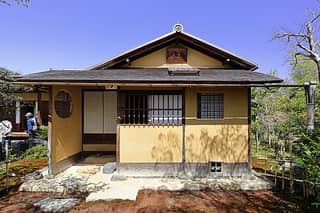
Why Jo-an is famous: a tea master's small room with a long journey
Jo-an is a surviving early-seventeenth-century tea house associated with Oda Uraku, celebrated for its distinctive design and National Treasure status. Its present Inuyama setting is not its original home.
Jo-an (如庵) is famous because it preserves an important work of Japanese tea architecture, not because it is a large palace. Japan's official tourism organisation identifies it as a masterpiece of early Edo-period architecture, built in 1618 by Oda Uraku, younger brother of Oda Nobunaga and a disciple of tea master Sen no Rikyu. The contrast is striking: a family remembered for military power also produced an enduring setting for the intimate practice of tea.
The date in this image's title, 2023, should therefore not be read as the building's construction date. The tea house belongs to the seventeenth century. The Japan Tourism Agency describes Jo-an as one of only three tea houses recognised as National Treasures. Its significance is both architectural and historical: it is a rare surviving place connected with an influential tea practitioner.
There are specific design features worth noticing rather than simply calling the building beautiful. The operator's official description draws attention to the Uraku windows, the diagonal wall and the central pillar, as well as the wooden-shingled roof and the sheltered earthen-floor entrance area. Those carefully arranged elements give a small room its distinctive character. A useful way to approach Jo-an is to ask how a room can create an experience through proportion, light and the relationship between its parts, rather than through sheer size. That last point is an interpretation of its design, not a claim that the photographer entered the room.
Jo-an also has a travelling history. It was originally built within the grounds of Kenninji in Kyoto, not at the foot of Inuyama Castle. Aichi's official tourism account traces its later moves through Tokyo and Kanagawa before its arrival in Inuyama in 1972. The same source dates its National Treasure designation to 1951. Today's Urakuen setting therefore brings an older building into a later garden; the age of the tea house and the age of its present setting must not be conflated.
In short, Jo-an is famous for the combination of an identifiable tea master, distinctive small-scale architecture, exceptional heritage recognition and survival through relocation. Visitors should also distinguish seeing the exterior from entering the historic room: the operator says the interior is normally closed, with access offered through special viewings. This account is based on published heritage and tourism sources, not an on-site visit.
- Japan National Tourism Organization: 1618 date, Oda Uraku and early Edo architectural importance.
- Japan Tourism Agency: Jo-an's place among three National Treasure tea houses and original Kyoto context.
- Site operator: roof, Uraku windows, diagonal wall, central pillar and interior access distinction.
- Aichi official tourism: relocations, 1972 arrival in Inuyama and 1951 designation.