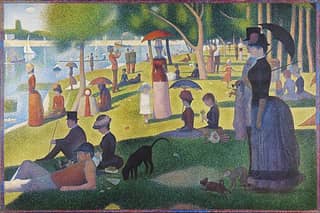
A Sunday two years in the painting: Seurat's A Sunday on La Grande Jatte
Seurat painted it from 1884 to 1886, using side-by-side dots of color to depict Parisians resting on the banks of the Seine. The painting is about 3 meters wide and was first exhibited in 1886. After Seurat died in 1891, the painting passed through the hands of family and friends for more than thirty years. In 1924 it arrived in Chicago, where it is now held at the Art Institute of Chicago.
[Where the image comes from]
This image is taken from the Wikimedia Commons file A Sunday on La Grande Jatte, Georges Seurat, 1884.jpg. Commons marks it as Public domain. The holding museum, the Art Institute of Chicago, also marks this work as public domain. The Commons source field for this file gives a link to a 2016 article in The Boston Globe, not the museum. So the original photographer of this digital image: uncertain.
[Fact: the work and where it is held]
The following is based on open data from the Art Institute of Chicago, accession number 1926.224.
The artist is Georges Seurat (1859–1891), a French painter. Original title: A Sunday on La Grande Jatte — 1884.
Date: 1884–86; the dotted painted border was added in 1888–89.
Oil on canvas, 207.5 × 308.1 cm.
Held at: the Art Institute of Chicago, in the Helen Birch Bartlett Memorial Collection.
[Fact: what is painted in the picture]
The following is based on the museum's description of the work.
The painting shows people on the bank of the Seine. Old and young, every class.
Up close, the people and objects break apart into dots of color and short brushstrokes. Complementary colors are placed side by side. This is Seurat's pointillist technique.
Seurat first made many small oil sketches and drawings, then several large canvases, to fix the positions of the landscape and the figures.
Two years after starting, Seurat returned to this painting. He strengthened the outlines of some figures and added new ones. The little monkey on a leash was added later. A man in the far distance holding a rolled newspaper was also added later, and is almost invisible.
The museum says Seurat wanted to paint a picture of modern life and make it as solemn as an ancient Greek frieze.
[Fact: exhibitions]
According to the museum's exhibition records: from May 15 to June 15, 1886, this painting was first shown at the eighth exhibition in Paris, catalogue no. 175. This was the last group exhibition of the Impressionist painters. The last sentence is a common claim; the museum's record does not state it, so I mark it: uncertain.
In February 1887 it was shown at the annual exhibition of Les XX in Brussels.
[Fact: provenance]
The following is based on the museum's provenance record.
When Seurat died in 1891, the painting went to his mother. After his mother died in 1899, it passed to Seurat's brother Émile.
In 1900, Émile sold it for 800 francs to Casimir Brû in Paris. That same year Brû gave it to his daughter Lucie. Lucie later married Edmond Cousturier.
In 1924, Frederic Clay Bartlett and Helen Birch Bartlett of Chicago bought it for $20,000. The intermediary may have been Charles Vildrac; the record uses "may have been."
In 1926, Bartlett donated the painting to the Art Institute of Chicago.
[Fact: a scene in a film]
The museum's description mentions that a scene in the film Ferris Bueller's Day Off was shot in this museum. Cameron stands in front of this painting, staring at it.
[AI interpretation, not a provenance conclusion]
Most of the people in the painting are seen from the side or from behind, and they rarely look at one another. My reading is: Seurat paints a lively Sunday as a quiet scene. People are together, yet each is alone. This point is only my interpretation.
