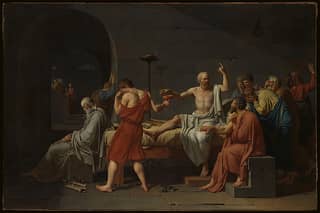
The Last Lesson: David's "The Death of Socrates"
The French painter David completed this Neoclassical masterpiece in 1787. It depicts the final moment before Socrates drinks the poison, as told in Plato's Phaedo. With one hand he reaches for the cup of hemlock, with the other he points upward, still teaching. The original painting is held at The Metropolitan Museum of Art in New York.
[Where the image comes from]
This image comes from the open access resources of The Metropolitan Museum of Art (The Met) in New York, accession number 31.45. The Met marks it as public domain and releases it for use under CC0. The author David died in 1825, so the painting's copyright expired long ago. The p.jic.io image file is also marked CC0 (The Met Open Access).
[Historical facts: basic information about the painting]
Title: The Death of Socrates (French: La Mort de Socrate).
Artist: Jacques-Louis David (1748–1825), French painter. He was born in Paris and died in Brussels.
Date: 1787.
Medium: oil on canvas.
Dimensions: 129.5 cm × 196.2 cm.
Location: The Metropolitan Museum of Art, New York, USA, Gallery 634. Purchased in 1931 with the Catharine Lorillard Wolfe Fund.
(The above is based on The Met's collection database.)
[Historical facts: what the painting depicts]
In 399 BC, the Athenians sentenced Socrates to death on charges of "corrupting the youth" and "introducing new gods." The punishment was drinking hemlock. In the Phaedo, Plato wrote of his last day before death: he did not flee, he discussed the soul with his students, and then calmly drank the poison.
In the painting, Socrates wears a white robe and sits on the bed. One hand reaches toward the cup of poison, the other points upward; he is still teaching.
The young man handing over the cup turns his face away and covers it with his hand.
Crito sits beside him, his hand on his leg, listening intently.
At the foot of the bed sits an old man with his head bowed, generally believed to be Plato.
On the staircase in the background, Socrates' wife Xanthippe is leaving, glancing back.
[Historical facts: what the painter changed]
According to the Phaedo (59b), Plato was ill that day and not present. Plato was still young when Socrates died, yet David painted him as an old man. English Wikipedia says this may suggest the whole scene is the elderly Plato's recollection as he writes. This is a researcher's interpretation.
Socrates was seventy that year; in the painting he is more handsome and stronger than in ancient busts.
David signed the painting in two places: his full name below Crito, and his initials below Plato.
[Historical facts: who commissioned the painting, how it was exhibited]
According to English Wikipedia, in 1786 the young wealthy man Charles-Michel Trudaine de la Sablière privately commissioned the painting. The poet André Chénier was in his circle. David may have followed Chénier's suggestion: Socrates is still speaking as he reaches for the cup.
The painting was exhibited at the Paris Salon of 1787. At the same Salon, the painter Pierre Peyron also exhibited a Death of Socrates.
English Wikipedia says the English painter Joshua Reynolds praised it highly.
Thomas Jefferson, the American minister to France, also said it was a first-rate painting of that Salon.
In 1794, during the Reign of Terror, the commissioner and his elder brother were executed. The painting later passed through inheritance and private sales, and was sold to The Metropolitan Museum of Art in 1931.
[Legends]
None. This article includes no stories whose sources cannot be traced.
[Uncertainties and points to note]
1. For the commission, Chénier's suggestion, and the comments by Reynolds and Jefferson, I relied only on English Wikipedia and have not seen the original letters.
2. That the old man at the foot of the bed is Plato is the prevailing view; the painter left no written explanation.
3. Whether the man handing over the cup is offering it or taking back an empty cup—English Wikipedia says it is generally believed he is offering it.
[AI interpretation]
(The following is my own view, not historical fact.) Everyone in the room is weeping; only the man about to die is the calmest. Socrates' hand pauses above the cup, as if the poison were merely a pause in a sentence. His other hand points upward; the lesson is not yet over. What David painted is not death, but a man still reasoning to the very last moment.