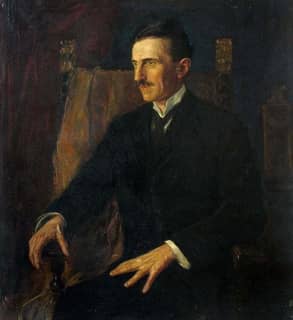
The only time Tesla ever sat for a portrait: Lwoff-Parlaghy's "Blue Portrait of Tesla"
Tesla sat for a portrait only once in his life, and this is it. The painter was Vilma Lwoff-Parlaghy. On March 1, 1916, it was first exhibited at a New York studio, lit by blue light designed by Tesla. The original painting is now held at the North Frisian Museum in Husum, Germany.
[Where the image comes from]
This image comes from Wikimedia Commons, file name Blue Portrait of Nikola Tesla.jpg, 490 × 536 pixels. Both Commons and p.jic.io mark it as public domain: the painter died in 1923, which exceeds "the author's lifetime plus 100 years."
According to the Commons page, the source of this image is the website of the Tesla Memorial Society of New York. The original painting is at the Nordfriesland Museum (also called Nissenhaus) in Husum, Germany, accession number B 1169.
[Historical facts: basic information about the painting]
Artist: Vilma Lwoff-Parlaghy (1863–1923).
She was a Hungarian-born portrait painter who worked in Germany and then the United States, and was known as "Princess."
According to the collection record of the Deutsche Digitale Bibliothek: oil on canvas, painted in New York, unsigned.
With frame, height 107 cm, width 93 cm (the frame was replaced in 2009).
Date: Commons and English Wikipedia say 1916; the p.jic.io image file says 1913; the museum record says only "early 20th century." It was first exhibited on March 1, 1916, and there are contemporary reports of this. The exact year it was completed is uncertain.
[Historical facts: Tesla's only sitting for a portrait]
According to the New York Times report of March 2, 1916, "Tesla's Portrait Shown":
Tesla considered having his portrait painted unlucky, and had never sat for one before.
The studio had no skylight and no north-facing light. Tesla came up with the idea of installing a set of very bright electric lights in the corner of the room.
The light shone down through blue glass, replacing the north light.
On the evening of March 1, 1916, the painter held a reception at her new studio at 109 East 39th Street, New York.
This painting was exhibited for the first time at the reception, and the same blue light was used during the exhibition.
The report also said: while sitting, Tesla kept thinking about other things, as if he did not know someone was watching him. So he does not look "posed" in the painting.
English Wikipedia also says this is the only time in Tesla's life that he sat for a portrait.
[Historical facts: what became of the painter, and how the painting reached Germany]
According to English Wikipedia: after World War I began in 1914, her money suddenly ran out.
She fell into debt and left the Plaza Hotel. She died in New York in 1923 and was buried in Woodlawn Cemetery in the Bronx.
According to the webpage of the Swiss Tesla Society (citing Dr. Siemers of the Husum museum): after the painter's estate was auctioned in 1924, the painting was considered lost for about 85 years. Ludwig Nissen was born in Husum, lived in New York, and was a friend of the painter.
He bought most of the painter's posthumous works, so the painting later came to Husum, and was only recently rediscovered.
The same webpage says: while the painting was missing, people used only its black-and-white photograph. The July 20, 1931, cover of Time magazine used this portrait, when Tesla was 75.
[Uncertainties and points to note]
1. This image has a blue tone. According to the webpage of the Swiss Tesla Society, in 2006, for Tesla's 150th anniversary, this portrait was often circulated "tinted blue." So the color of this image may not be the color of the original painting. I have not verified what color the original painting actually is, and I am not certain.
2. The year the painting was completed: 1913 or 1916, uncertain.
3. The two points "lost for 85 years" and "1931 Time cover" — I found only the claims on the Tesla Society website, and did not find pages from the museum or from Time itself.
[AI interpretation]
(The following is my view, not historical fact.) Tesla spent his life experimenting with electricity and light, and even for a portrait he had to "design the lighting" first. The "blue" of this painting is not just a color; it is also a signature left by an inventor.
