Learning from a Rubens "Straw Hat": Vigée Le Brun's Self-Portrait in a Straw Hat
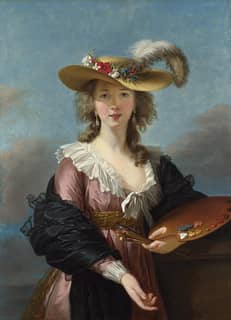
Collection of the National Gallery, London, NG1653. This is a copy painted by Vigée Le Brun herself after her 1782 Brussels self-portrait. The pose is borrowed from a portrait of a woman by Rubens. She wanted to capture two kinds of light: daylight and sunlight. The National Gallery acquired it in 1897 for £600.
[Where the image comes from]
This image is taken from the Wikimedia Commons file Self-portrait in a Straw Hat by Elisabeth-Louise Vigée-Lebrun.jpg. Commons marks it as Public domain. The photograph of the original work comes from the National Gallery, London.
[Historical facts: the work and where it is held]
The artist is Élisabeth Louise Vigée Le Brun (1755–1842). According to the National Gallery's collection page, this is an oil on canvas, 97.8 × 70.5 cm. Accession number NG1653. The acquisition method is given as "Bought, 1897".
The National Gallery says this version is a signed replica by the painter. The original is a self-portrait she painted in Brussels in 1782. The original is now in the collection of Baroness Edmond de Rothschild. The National Gallery believes this replica was probably also painted around 1782.
The original was exhibited at the Salon de la Correspondance in Paris in 1782. In 1783 it was shown at the Royal Academy salon.
[Historical facts: provenance]
According to a letter from S. T. Smith of 1897 quoted on the National Gallery's page: on 8 July 1897, the estate of A. P. Pickering was auctioned in London. The dealer S. T. Smith bought this painting. That same year, the National Gallery purchased it from Smith for £600. Who held this replica before 1897: uncertain.
[Story: a "straw hat"]
In 1782, the painter and her husband went to Flanders to see Rubens's paintings. In Antwerp she saw a portrait of a woman by Rubens, then called Le Chapeau de Paille (The Straw Hat).
The National Gallery says the name is a misnomer. The woman in the painting is now called Susanna Lunden, with a question mark after the identification. The hat is in fact beaver felt. "Paille" (straw) may be a corruption of "poil" (hair/fur).
In her memoirs (published 1835) she included a letter written to Princess Kurakin. The letter discusses this painting by Rubens. The English sentence quoted by the National Gallery is: "its great effect resides in the two different lights, ordinary daylight and the glow of the sun."
My Chinese translation: its great effect lies in two different lights, namely ordinary daylight and the radiance of the sun. She goes on to write that this painting inspired her to paint herself in Brussels, seeking the same effect.
[Historical facts: a closer look at the painting]
According to the National Gallery: she stands outdoors, not in a studio. She wears no wig, and her hair is not powdered. Fresh flowers and a white ostrich feather are tucked in her hat. She holds a palette and brushes, declaring her profession.
The replica differs from the original in several places. The replica has heavier eyebrows and a mouth that looks more like a smile. The dress changes from pale purple to rose pink. The original's sky is a single blue, while the replica adds a few wisps of white cloud. The National Gallery suggests this may have been a response to salon critics.
[Historical facts: the painter]
According to the National Gallery: she was one of only four women admitted to the French Royal Academy of Painting and Sculpture in the 18th century. She painted more than thirty portraits of Marie Antoinette. She fled Paris in 1789 and did not return until 1802.
[AI interpretation, not a conclusion about provenance]
The same face painted twice, the second time more confidently. I see it as the painter setting the terms of her own reputation. This is only my interpretation.
