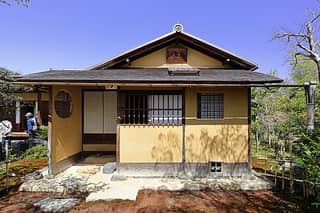
Why Jo-an at Urakuen is famous
The English filename says Joan, but this is Jo-an (如庵), a National Treasure tea house in Urakuen garden at Gomonsaki, Inuyama. It is famous as one of only three surviving National Treasure chashitsu, built by Oda Uraku and moved here in 1972.
The photograph is not of Joan of Arc. The Commons caption, in Japanese, reads that this is Jo-an (如庵) inside Urakuen (有楽苑), at Inuyama, Aza Gomonsaki, photographed on 28 March 2023. English romanization turns 如庵 into Joan or Jo-an, which is why the filename looks like a saint.
Urakuen sits just east of Inuyama Castle, at 1 Inuyama-Gomonsaki. The garden was laid out by Nagoya Railroad and opened in 1972 so the tea house would have a proper setting. The garden's name comes from Oda Uraku (織田有楽斎, also Oda Nagamasu), younger brother of Oda Nobunaga and a major figure in early chanoyu.
Jo-an itself is older than the garden. Uraku built it around 1618 at Shoden-in, a subtemple of Kennin-ji in Kyoto, after he retired. It is a small two-and-a-half-mat tea room (nijōhan-daime). Visitors and guides point to three details: the Uraku window of tightly packed bamboo, koyomibari walls papered with old calendar sheets, and a slanted wall beside the alcove.
It was named an Important Cultural Property in 1936 and a National Treasure in 1951. It is one of only three tea rooms that still hold that rank, with Tai-an at Myōki-an in Yamazaki and Mittan at Ryōkō-in, Daitoku-ji. After later moves, including time with the Mitsui family and at Ōiso, it was relocated to Inuyama in 1972. Of the three, Jo-an is the one whose exterior can usually be seen from the garden paths. Going inside is limited and generally by reservation.
The same garden also holds the former Shōden-in shoin, an Important Cultural Property, and the tea rooms Gen-an and Kō-an, where matcha is served. What makes the place famous is not a statue. It is a National Treasure tea room that survived four centuries of moves and still sits, small and usable, in a Meitetsu garden beside Inuyama Castle.
