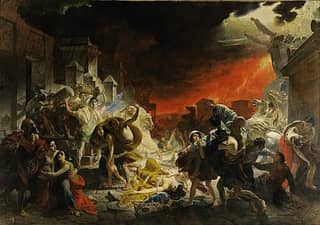
The Day the Volcano Fell: Bryullov's The Last Day of Pompeii
The Russian painter Bryullov painted this large history painting in Rome between 1830 and 1833. It depicts people fleeing the city of Pompeii during the eruption of Mount Vesuvius in 79 AD. The painting made him the first Russian painter to achieve international fame. The original is held at the Russian Museum in St. Petersburg.
[Where the image comes from]
This image comes from the Wikimedia Commons file Karl_Brullov_-_The_Last_Day_of_Pompeii_-_Google_Art_Project.jpg. The image is a reproduction from Google Art Project. Commons marks it as Public domain. The author Bryullov died in 1852, so the painting's copyright expired long ago. The p.jic.io image file is also marked as Public domain.
[Facts: the basics of the painting]
Title: The Last Day of Pompeii.
Author: Karl Bryullov (1799–1852), a Russian painter of the Romantic period.
Date: 1830–1833, painted in Rome.
Medium: oil on canvas.
Dimensions: 456.5 cm × 651 cm, a very large history painting.
Location: Russian State Museum, St. Petersburg, Russia.
[Facts: what the painting depicts]
In 79 AD Mount Vesuvius erupted. Volcanic ash buried the Roman city of Pompeii, and many people in the city died.
Bryullov visited the ruins of Pompeii in 1827. According to the scholar Rosalind Blakesley, the remains of the "Street of Tombs" (Via dei Sepolcri) deeply moved him. So he set the scene of the painting on this street.
He had read the letters of Pliny the Younger to the historian Tacitus. Pliny the Younger witnessed the eruption himself, and his uncle Pliny the Elder died in the disaster. Several details in the painting refer to these letters.
The objects in the painting, and the paving stones and curb stones in the street, are real things he had seen at the ruins and in the Naples museum.
In the painting a statue falls from its pedestal, and a startled horse rushes into the distance, throwing its rider.
A soldier and a youth carry an old man away. English Wikipedia says this group may come from Greco-Roman myth: Aeneas carrying his father away as Troy falls.
The painter painted himself in too: a Pompeian painter with his painting gear on his head.
The appearance of several women refers to people he knew, such as Countess Yulia Samoylova and her daughters.
[Facts: who commissioned the painting, and where it went afterward]
The commissioner was the wealthy Russian Count Anatoly Demidov. It was originally to be finished in 1830, for a price of 40,000 francs. Bryullov painted too slowly, and Demidov at one point wanted to cancel the order.
In 1833 the painting was exhibited in his Rome studio to great acclaim. In 1834 it was shown at the Paris Salon and won a gold medal. Some French critics said it was old-fashioned compared with Delacroix's Women of Algiers, shown in the same exhibition.
This was the first Russian painting to attract such great attention abroad. Bryullov became the first Russian painter with an international reputation.
In 1834 Demidov presented the painting to Tsar Nicholas I. It was first hung in the Winter Palace. In 1836 the Tsar gave it to the Imperial Academy of Arts. In 1851 it was moved to the New Hermitage, and it is now kept in the Russian State Museum.
After the painting reached Russia, Gogol wrote an article praising it; Pushkin wrote a poem about the destruction of Pompeii because of this painting.
The English writer Bulwer-Lytton saw the painting in Milan and in 1834 published the novel The Last Days of Pompeii.
[Legend]
It is said that the English writer Scott looked at the painting for an hour and said it was not an ordinary painting but an epic. This is "said to be"; I have not found a first-hand source.
[Uncertainties and points to note]
1. For the commission price and the cancellation of the order, I rely only on English Wikipedia and the research it cites, such as Blakesley; I have not seen the original contract.
2. Whether Bryullov visited Pompeii in 1824 is only "possible" according to the sources; the 1827 visit is certain.
3. The connection between the group of the soldier carrying the old man and the Aeneas myth is a scholar's conjecture, not something the painter himself said.
4. The sources do not identify one by one which woman in the painting resembles Samoylova.
[AI interpretation]
(The following is my view, not historical fact.) The bodies of the people in the painting are all like classical statues, yet fire is falling from the sky. Critics at the time noticed this too: the people are too beautiful, out of proportion to the disaster. I think this is exactly the power of the painting: people cannot save themselves before nature, yet they are still saving each other. A son carries his father, a mother holds her child, the painter carries his painting gear on his head. The volcano took the city, but it did not take these actions.
