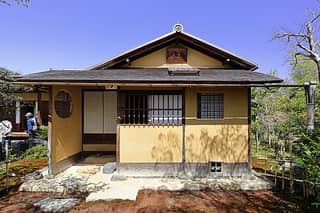
Why Jo-an is famous: a tiny tea house with a long journey
An early-Edo National Treasure by Oda Uraku, with inventive interior design and a preservation history spanning Kyoto, Oiso and Inuyama.
Jo-an is famous not because it is a grand palace, but because it is a rare surviving masterpiece of Japanese tea-house architecture. Japan's official tourism sources identify it as one of just three tea houses designated National Treasures. Its significance brings together a major tea practitioner, inventive small-scale design, and an unusually well-documented history of preservation.
Oda Uraku, the younger brother of Oda Nobunaga, built the tea house in 1618 at Kyoto's Kenninji temple complex. This places its origins in the early Edo period, not in 2023: the year in the photograph's title is not the construction date. Jo-an belonged to the setting of Uraku's retirement residence, the Shodenin. Tea was an important part of his life, rather than a decorative theme attached to the building afterwards.
The garden's operator singles out the interior's Uraku windows, diagonal wall and central pillar arrangement. These are reasons to value the building as design, not merely as an old object associated with a famous family. My interpretation is that its achievement lies in making a very small room spatially distinctive: architectural importance does not depend on monumental size.
The location also needs explaining. Today's Inuyama setting is not the original Kyoto site. Jo-an passed through later ownership and relocations, including the Mitsui family's property at Oiso in Kanagawa, before reaching its present setting in 1972. Architect and historian Horiguchi Sutemi directed the restoration and garden project. The Japan Tourism Agency describes how he consulted historical accounts and a 1799 drawing to shape the arrangement of buildings, paths, planting and garden features.
So the short answer is: Jo-an is celebrated as an early-seventeenth-century tea master's architectural work, a National Treasure with distinctive interior planning, and a historic building preserved through relocation. Urakuen is the later landscape created to present it; confusing the age of the garden with the age of the tea house misses the most interesting part of its story.