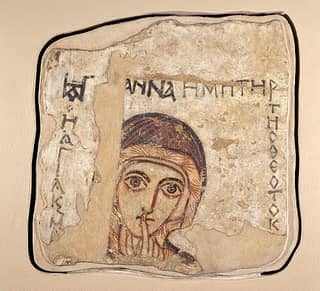
Fresco Fragment of Saint Anne: Nubian Christian Art from Faras Cathedral
Fresco fragment of Saint Anne from Faras Cathedral in the Kingdom of Makuria, 8th–9th century, tempera on plaster, excavated by a Polish archaeological team in the 1960s, now in the Faras Gallery of the National Museum in Warsaw.
This image is a fragment of a wall painting depicting Saint Anne (the mother of the Virgin Mary), from the Faras Cathedral in ancient Nubia (present-day northern Sudan). It belongs to the Christian wall paintings of the Kingdom of Makuria, painted around the 8th–9th century (some say the 7th–9th century), in al secco tempera on silt plaster; the fragment measures about 69 × 68.5 cm.
It is important for three reasons:
1. Precious provenance — Faras was a major center of early Nubian Christian art. In the 1960s, to rescue sites that would be submerged by the Nasser Reservoir (the Aswan High Dam), UNESCO launched the "Nubia Campaign"; the Polish archaeological team led by Professor Kazimierz Michałowski excavated a large number of wall paintings there, and Saint Anne is one of them.
2. Clear history — it entered the collection of the National Museum in Warsaw in 1964 and is displayed in Room VI of the Faras Gallery, accession number 234058.
3. High recognizability — the image of Saint Anne is used by the National Museum in Warsaw as its logo, making it one of the museum's most representative holdings.
In the painting Saint Anne has a calm expression, typical of Nubian Byzantine-style religious painting. The original site is at approximately 22.1817°N 31.4969°E (near present-day Wadi Halfa, Sudan).