Who is this mural: the fragment of Saint Anne from Faras
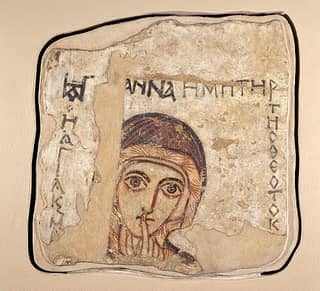
This is not a readable long text, but a fragment of a mural from the cathedral of Faras in Nubia: Saint Anne from the 8th to 9th century, now in the National Museum in Warsaw, of which only the head, shoulders and a hand raised to the lips remain.
What this painting has to answer is "what is this saying." There is no long inscription on the surface that the viewer can read word for word; what remains is a face, a shawl, and a right hand raised to the mouth. It is a fragment of a wall painting from the Faras Cathedral in Makuria (medieval Nubia), and the subject is Saint Anne, the mother of the Virgin Mary. It measures roughly 69 by 68.5 centimeters, painted in tempera on mud plaster in a dry fresco technique, dated to around the 8th to 9th century, artist unknown.
It was originally painted on the wall of the north nave of Faras Cathedral, about 3 meters above the floor, and belongs to the earliest plaster layer. This layer was later covered, and over it a composition of Queen Martha was painted. In the 1960s a Polish archaeological team detached it during the UNESCO Nubian salvage campaign. Before the Aswan Dam impounded its waters, the ancient city of Faras was submerged. Since 1964 the fragment has been kept in the National Museum in Warsaw, displayed in Room 6 of the Faras Gallery, accession number 234058, and the museum has even used this face as its logo.
So "what it is saying" can be taken on two levels. The image itself identifies Saint Anne: the north nave may have been associated with female worshippers, and Saint Anne here is not an isolated decoration. As for the gesture of the hand near the lips, researchers read it in different ways; one common reading is a sign for silence or silent prayer, but the fragment lacks the lower body and the adjacent figures, so no single interpretation can be written as settled fact. What can be certain is this: it is Saint Anne, rescued from the wall of a submerged Nubian church, not a modern imitation.
