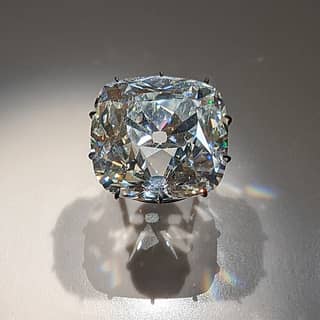
The Diamond Stolen Twice: Once Hidden in a Woodshed Loft, Once Left Behind by the Thieves
The Régent Diamond (Le Régent) now weighs 140.64 metric carats, nearly colorless "first water." Louvre: discovered around 1698 in the Golconda mines of India (the Golconda area, Kollur often cited, with an alternative claim of Paritala; the museum does not name the mine); rough stone approximately 410–426 carats, accounts vary; cut in England 1704–1706; sold on 1717-06-06 to Philippe II, Duke of Orléans, the Regent. Accession number MV 1017, traditionally displayed in the Apollo Gallery; the Louvre collection page currently marks it non exposé (not on display). Shares the same mining-region tradition, the same crown, and the same 1792 great theft as #6 the Hope Diamond, but it is not the same rough stone.
Three things first: origin, weight, current location. The Louvre collection page states: this stone was discovered around 1698 in the Golconda (Golconde) mines of India. The museum does not name the specific mine—Kollur is often cited, and Indian media offer an alternative claim of Paritala on the Krishna River; here we write only "the Golconda area (Kollur often cited)," without settling it. After cutting it weighs 140.64 metric carats; French state property, Louvre Department of Decorative Arts, accession number MV 1017, transferred to the Louvre in 1887, traditionally displayed in the Apollo Gallery (Louvre Kids marks it Salle 705). But note: the Louvre collection page currently marks it "non exposé" (not on display). So this article writes only "now in the Louvre, collection page currently marked not on display," and does not say which case it is in at this moment.
The stone itself: nearly colorless, the museum says slightly blue-green, called "first water" (première eau). Rectangular cushion shape, old brilliant cut. Accounts of the rough stone's weight vary, approximately 410–426 carats (the Louvre writes 426, Britannica writes about 410); this article does not adopt a single number. Arrived in England around 1702, cut 1704–1706; the cutter's name is recorded differently in various places (the collection narrative and the entry fields differ), pending verification, so no name is given here.
How it came to France: after cutting it was called the Pitt Diamond, after Thomas Pitt, Governor of Madras. On June 6, 1717, Philippe II, Duke of Orléans, the Regent, persuaded the Regency Council to purchase it, and from then on it was called "Le Régent." It later appeared on the coronation crowns of Louis XV in 1722 and Louis XVI in 1775; Napoleon had it set on his sword (one account says it was the one worn at the 1804 coronation); later it entered the crowns of Louis XVIII, Charles X, and Napoleon III, and the Greek-style tiara of Empress Eugénie.
First theft: during the Revolution in 1792, the Garde-Meuble royal jewel repository was burglarized, and it was stolen in the same case as the French Blue; recovered in 1793, one account says it was hidden in a gap in the attic of a wooden building in Paris (accounts vary between woodshed, attic, and crack). In the same case, the French Blue disappeared, later recut into the Hope Diamond—this chain has long been doubted and was confirmed by recent reconstruction, see #6.
Second time: in October 2025, the Apollo Gallery of the Louvre was robbed, and multiple pieces of crown jewelry were taken. The Régent was in the same gallery and was not taken. These two events are stated as facts only, without the sentimentality of "escaped two calamities."
The relationship with #6 must be made clear: both belong to the Indian Golconda production-region tradition (Kollur is only often cited for both); both belong to the French crown jewels; both are in the same 1792 great theft (one recovered, one lost and recut); the Smithsonian records that in 1962 the Hope was loaned to the Louvre and displayed together with the Régent. But they are not the same rough stone.
All legends are placed in quotation marks: "the slave hid the rough stone in a leg wound to carry it out of the mine" is widely circulated, not recorded in the Louvre's main text, and not treated as historical fact; "curse" is handled the same as in #6. Saint-Simon said it was "as large as a Queen Claude plum," a contemporary impression.
(Seventh in the picture-story series; #6 the Hope Diamond https://p.jic.io/s/s-4f53ecda0222 )