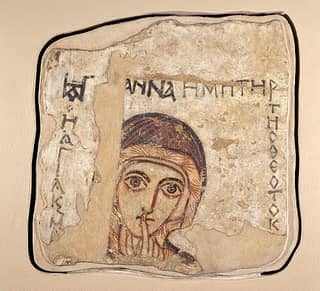
Image of Saint Anne: A Nubian fresco fragment from Faras Cathedral
The image of Saint Anne (mother of the Virgin Mary) is a fragment of an 8th–9th century fresco from the Nubian kingdom of Makuria, painted in tempera on plaster, from Faras Cathedral in present-day northern Sudan. It was excavated in the 1960s by a Polish archaeological team during the UNESCO "Nubia Campaign" and has been held since 1964 in the Faras Gallery of the National Museum in Warsaw (accession no. 234058). In the painting, Saint Anne touches her lips lightly with the index finger of her right hand—the only known image of Saint Anne making this "hush" gesture—and it later became the emblem of the National Museum in Warsaw.
This fragment depicts Saint Anne—the mother of the Virgin Mary and traditionally regarded as the grandmother of Christ. It is a wall painting from the ancient Nubian kingdom of Makuria, painted around the 8th–9th century in tempera applied al secco on silt plaster, measuring approximately 69 × 68.5 cm.
The painting comes from Faras Cathedral—located at Faras in ancient Nubia (in present-day northern Sudan, in the Wadi Halfa area). In the 1960s, to rescue Nubian monuments that would be submerged by the rising waters of the Aswan Dam, UNESCO launched the "Nubian Campaign"; a Polish archaeological team excavated this group of wall paintings at Faras Cathedral, and the Saint Anne image is one of them. Since 1964, the image has been held at the National Museum in Warsaw, Poland, displayed in Room VI of the Faras Gallery, accession number 234058.
Only the head and shoulders survive, along with the right hand raised to the lips—the tip of the index finger lightly touching the lips. Saint Anne wears a purple-red hooded cloak (maphorion); her face is long and slender, with a straight nose and wide-open eyes; notably, her head has no halo, which is quite rare for a holy icon. According to excavation records, the painting was originally on the wall of the north nave, about 3 meters above the floor, painted on the first layer of plaster and later covered by a second layer of plaster (the portrait of Queen Martha); the north nave was very likely an area for women's prayer.
Greek inscriptions remain on the painting, which S. Jakobielski reads as "Saint Anne, mother of the Mother of God…". Saint Anne does not appear in the canonical Gospels but is found in documents such as the Gospel of James (a 2nd–3rd century apocryphal text written in Greek) and the Gospel of Pseudo-Matthew—according to tradition, she and Saint Joachim were childless in old age and, through devout prayer, were given a daughter, Mary.
Most distinctive is her gesture: placing the index finger on the lips. Although there are several images of Saint Anne in Nubia, the Faras one is the only known example making a "hush" gesture. Scholars offer several interpretations: it may be a sign meaning "keep silence"; or it may point to "the silence of God"—the threefold mystery concerning Mary spoken of by Ignatius of Antioch (the immaculate conception, the virginity, and the birth of the Messiah); it may also derive from the monastic tradition of Egypt and Palestine of "touching the lips with the right index finger during prayer, to ward off evil and protect the heart". This mysterious yet gentle gesture has made this fragment one of the most renowned images among the Faras wall paintings, and it is even used by the National Museum in Warsaw as its emblem.