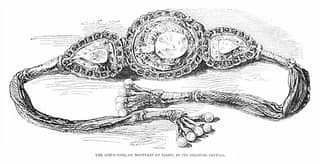
Koh-i-Noor at the Crystal Palace, 1851
An 1851 exhibition engraving of the Koh-i-Noor in its pre-recut Indian setting, printed in The Crystal Palace and its Contents.
This plate is not a photograph of the modern Koh-i-Noor in the British Crown Jewels. It is a mid-19th-century illustration of the diamond as shown at the Great Exhibition of 1851 in London, still in the Mughal-derived oval setting it had when it left the Punjab.
The print is dated 1 November 1851 on Wikimedia Commons and is taken from The Crystal Palace and its Contents: An Illustrated Cyclopaedia of the Great Exhibition 1851 (Internet Archive scan, around the “page 68” opening). The draughtsman is uncredited. Commons treats the file as public domain in the United States because the book was published long before 1931.
What the picture is useful for: it freezes the stone *before* Garrard recut it in 1852 for Queen Victoria. Later publicity photos of the Imperial State Crown show a different silhouette. The 1851 display itself was controversial: visitors complained the diamond looked dull under exhibition lighting, which is one reason the recut was commissioned.
The name Koh-i-Noor (“Mountain of Light”) is Persian. The stone’s documented path runs through Mughal, Afghan, Sikh, and then British hands after the 1849 Treaty of Lahore. India and other states still dispute ownership; this caption is about the 1851 image, not a legal claim.
Do not confuse this engraving with later studio photos of the recut gem. The JIC record title “Kohinoor” plus year 1851-11-01 matches the Commons file Kohinoor.jpg, not a 20th-century crown close-up.
