Why Jo-an in Urakuen is famous
Jo-an in Inuyama's Urakuen is a National Treasure tea house built about 1618 for Oda Uraku, Nobunaga's brother, and moved here in 1972.
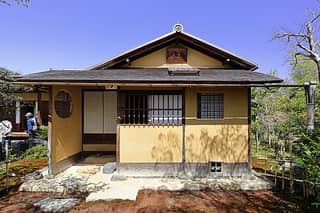
The photograph shows Jo-an (如庵), the early-seventeenth-century tea house that now stands in the Urakuen garden at Gomonsaki, Inuyama, Aichi. It is famous because it is one of Japan's three National Treasure tea rooms, built for a tea master who was also Oda Nobunaga's younger brother, and because the building itself is an unusually personal piece of wabi architecture that survived several moves.
Oda Nagamasu, known as Urakusai, had the room made around 1618 at the Shoden-in subtemple of Kennin-ji in Kyoto. He was a disciple of Sen no Rikyu and founded his own Uraku school of tea. The Agency for Cultural Affairs lists Jo-an as a National Treasure of the residence type; the designation under the postwar law dates to 1951. With Tai-an at Myoki-an and Mittan at Ryoko-in of Daitoku-ji, it is counted among the three celebrated National Treasure tea rooms.
The room is small on purpose: two and a half tatami plus a daime, a tokonoma, a crawl-in nijiriguchi, a shingled roof, and a preparation area beside it. What makes the design recognizable is Uraku's own vocabulary. The tightly latticed bamboo urakumado breaks the light into soft stripes on the paper screens. Lower wall panels were papered with old calendars, a wabi reuse called koyomibari. The central post, angled sleeve wall, and scale-pattern floorboards are not a copy of Rikyu's austerity; they are lighter, more playful, and still severe.
After Kyoto the building passed through the Mitsui family, including a villa in Oiso, and in 1972 Meitetsu reassembled it in Inuyama, next to Inuyama Castle, inside a garden named Urakuen after Uraku. The 2023 photograph by Tomio344456 is the exterior as visitors meet it there: a thatched hermitage in a strolling garden, not the Kyoto temple where it was first used. Most people see the garden and the shell; the interior is limited. The fame is the object, not the view: an original tea room by Nobunaga's brother, still one of only three tea houses Japan ranks as a National Treasure.
