"Zhaizi Zhongguo": a 30-yuan wine vessel bought back from a scrapyard, with 122 characters hidden on its inner base—the He zun
The He zun is an early Western Zhou bronze wine vessel, unearthed in 1963 at Jiacunyuan, Baoji, Shaanxi. In 1965, according to records, it was acquired by the Baoji Municipal Museum for 30 yuan from a scrap collection station; only in 1975, while being cleaned of rust, was a 12-line, 122-character inscription discovered on its inner base. The inscription quotes King Wu: "I shall reside in this Zhongguo and from here govern the people"—the earliest known written record of "Zhongguo" (China) as a phrase. Here, however, "Zhongguo" refers to the area around Chengzhou (Luoyi), the center of the realm, not "China" in today's sense of a nation. It is now held in the Baoji Bronze Ware Museum.
In August 1963, villager Chen Dui of Jiacunyuan in Baoji County (now Chencang District) dug up a bronze vessel in his backyard. He took it home for a while to store grain, and later his brother Chen Hu sold it to a scrap collection station. In September 1965, Tong Taifang, a cadre at the Baoji Municipal Museum, recognized it at the collection station; museum director Wu Zengkui sent Wang Yongguang, head of the conservation department, to examine it. Records say the museum acquired it for 30 yuan and named it the "Taotie Bronze Zun" after its decoration. (Dong Shan's "Zhaizi Zhongguo: A New Interpretation of the He Zun" records that Wang Guangyong discovered it in September 1966, differing from the mainstream account; the mainstream version is followed here.)
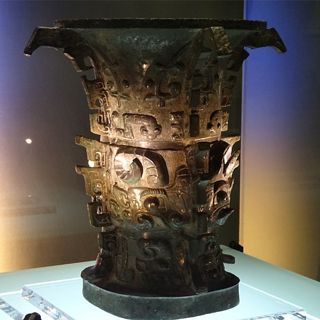
It stands 38.8 cm tall (another page from the Baoji Municipal Cultural Relics Bureau gives 38.5), with a mouth diameter of 28.8 cm and a weight of 14.6 kg. It has a round mouth and square body, four flanges, and high-relief animal-mask patterns on the belly and foot ring, with curled horns projecting from the surface.
The cold detail is inside. In 1975 the National Cultural Heritage Administration organized the "National Exhibition of Newly Unearthed Cultural Relics" at the Palace Museum in Beijing, and this zun was transferred to Beijing. Only while removing rust was a 12-line, 122-character inscription (including 3 combined characters; a hole in the bottom of the zun damaged 3 characters, and Ma Chengyuan's 1976 "Preliminary Interpretation of the He Zun Inscription" records 119 surviving characters) found on the inner base. According to the mainstream account, it was the bronze scholar Ma Chengyuan (later director of the Shanghai Museum) who discovered the inscription while removing rust, and the vessel was named the He Zun after its owner, "He"; the application filed with the National Archives Administration, however, records that Xu Yuming removed the rust, noted as an alternative account. It sat in the museum for ten years, and no one knew there were characters underneath.
The gist of the inscription: the king first moved his residence to Chengzhou; in the fourth month, on the bingxu day, he admonished the royal clan's younger members in the Jing chamber, reviewing how King Wen received the mandate and King Wu conquered the Shang; after conquering the Shang, King Wu once reported to Heaven in court: "I shall reside in this central domain (guo), and from here govern (originally written 辥) the people"—I want to live in the center of this world and govern the people from here. He was awarded thirty strings of cowries and made this zun, dated "in the fifth year of the king's reign." In the inscription, "guo" (国) is written as "或."
Caveat: this is currently the earliest known written record of "Zhongguo" as a phrase, but it refers to the area around Chengzhou (Luoyi) in the center of the world, not the same concept as the modern state of "China"—the application published by the National Archives Administration also states this. The mainstream view holds that the "king" is King Cheng of Zhou and that the vessel was made in his fifth year, which can be corroborated with the building of Chengzhou recorded in the "Shao Gao" chapter of the Book of Documents and the "Du Yi" chapter of the Lost Book of Zhou; Dong Shan and others instead attribute it to King Kang. In January 2002, the National Cultural Heritage Administration's "First Batch of Cultural Relics Prohibited from Exhibition Abroad" listed 64 items, and the He Zun is among them. It is now in the Baoji Bronze Ware Museum.
A wine vessel that nearly went back into the furnace, with a Zhou king's words "reside in this central domain" pressed beneath it from three thousand years ago.
(Image: He Zun, collection of the Baoji Bronze Ware Museum. Photo by Ghost Bani, Wikimedia Commons, CC BY-SA 3.0; this image is shared under the same license. This piece is the Chinese version of No. 5 in the "Huaxia Shiyi" series.)
- 国家档案局《何尊等五组周代有铭青铜器_申报书》:出土与征集经过、122 字、成王五年、与今「中国」非同一概念、徐毓明除锈
- 宝鸡市文物局《首批禁止出国(境)展览文物——何尊》:装粮食、30 元、故宫除锈、尺寸 38.5
- 宝鸡市文物局 2025 提案答复函:2002 年首批 64 件目录
- 陕西档案信息网:38.8 / 28.8 厘米、14.6 千克;马承源发现铭文并命名
- 马承源《何尊铭文初释》,《文物》1976 年第 1 期:除锈发现铭文、破孔损伤三字、现存 119 字
- 董珊《「宅兹中国」——何尊新说》:释文、合文 3、康王说;记为 1966 年王光永发现(异说)
- 配图:幽灵巴尼,CC BY-SA 3.0,Wikimedia Commons
