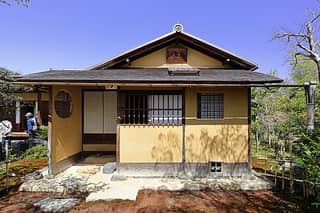
Why Jo-an is famous: a small tea house with a long journey
An early Edo tea master’s inventive room, preserved through relocation and a carefully researched garden setting.
Jo-an is famous not because it is grand, but because a very small building preserves an unusually distinctive approach to tea architecture. It is one of the three tea houses identified as National Treasures by Japan's tourism and heritage authorities. The “2023” attached to this image record is not the building's construction date: the tea house dates to around 1618.
Its designer was Oda Uraku, also called Urakusai, the younger brother of Oda Nobunaga. Uraku built Jo-an beside his retirement residence at Kenninji in Kyoto. That origin matters: the tea house now stands in Inuyama, but it was not originally built in the garden where visitors encounter it today. Japan's national tourism organization describes it as an important example of early Edo-period architecture.
The details explain why specialists care about it. Inuyama's cultural-heritage guide identifies old calendars pasted onto the walls, known as koyomibari, and a window with closely spaced bamboo slats, the urakumado. The garden's operator also highlights its diagonal wall and central pillar. These are specific design choices, not merely a generic image of a rustic Japanese hut. My interpretation is that Jo-an rewards attention to how an intimate room is composed: the window, wall surface and unusual geometry are the attraction, rather than monumental size.
Its survival is also a history of relocation. After leaving Kyoto, the buildings changed hands and locations; the Mitsui family kept Jo-an and part of the adjoining Shodenin residence at Oiso in Kanagawa. Architect and historian Horiguchi Sutemi later directed their restoration and the creation of their new setting at Urakuen. The Japan Tourism Agency explains that he studied historical records and a 1799 drawing, even using them to inform stepping stones, planting and fences. The present garden is therefore a carefully researched modern setting for a much older building, not an untouched seventeenth-century site. JNTO dates the move to the present setting to 1972.
In short: Jo-an combines a significant tea master's authorship, recognizable architectural inventions, exceptional heritage status, and a remarkable preservation history. A visit is best understood as looking at both an early Edo tea house and the later work that made its survival possible. The operator says the interior is normally closed except for special viewings; seeing the garden does not automatically mean entering the room.