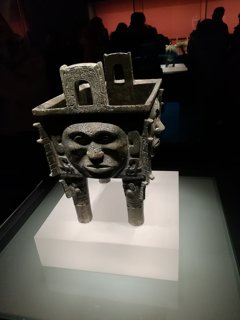
A 3,000-Year-Old Face That Nearly Went Into the Furnace: The Da He Square Ding with Human Faces
A late Shang bronze square ding found around 1959 at Huangcai, Ningxiang, Hunan, smashed and sold as scrap, then rescued from scrap-copper warehouses. Each side bears a human face; it is the only known Shang-Zhou fangding with a human face as its main motif. Its inscription 大禾 is still debated.
Around 1959 (the Hunan Provincial Museum's article gives "around 1958–1959"; the 2013 state list gives 1959), a farmer in Huangcai, Ningxiang County, Hunan, dug up a bronze vessel while working the land. It was the years of the nationwide steel-making drive, when copper and iron were collected for recycling. The vessel was smashed into pieces, sold along with the household's scrap iron, and ended up in the Maojiaqiao scrap-copper warehouse in Changsha, waiting to be sent to a smelter. In the museum's account, a Hunan Provincial Museum worker stationed at the warehouse to pick out cultural relics recognized one of the fragments, followed the trail, and recovered more than ten pieces. Put back together, it was missing only one leg and its base. Restorer Zhang Xinru first gave it a replacement leg; two years later the real leg was found too, and the replacement came off.
Other accounts differ on the details. Some name the finder as a farmer surnamed Huang (China Collection Network, 2010; The Paper, 2024); a 2022 Changsha Evening News series names him as surnamed Deng. Several local accounts (Changsha Evening News, 2022; Rednet columns by Chen Xianshu, 2017, and Jiang Feng, 2020) say that the missing pieces were traced along the scrap route to a scrap-copper warehouse in Zhuzhou, and that the real leg turned up there, not at Maojiaqiao; the museum's own text says only that the leg was found two years later. The account above follows the museum.
What came back together was a rectangular ding: 38.5 cm high overall, with a mouth 29.8 cm long and 23.7 cm wide; Shanghai Museum's record gives its weight as 12.85 kg. It has two upright handles, four columnar legs, and flanges at the four corners. Each of its four sides carries a human face in half relief: thick brows, large eyes, high cheekbones, a broad nose, a wide mouth pressed shut, and large ears on either side. But it is not just a face. Angular horns curl out from both sides of the forehead, animal claws grow from both sides of the chin, and cloud-and-thunder patterns fill the space around it. The museum reads it as a half-human, half-beast deity with a head, horns, and claws, whose body is left out because the vessel wall is flat.
The main motifs on Shang and Zhou bronzes are mostly animal masks; realistic human faces are extremely rare. Both the Hunan Provincial Museum and the Shanghai Museum say this is the only fangding known so far among Shang and Zhou bronzes decorated with a human face as its main motif.
Two characters, "Da He" (大禾), are cast on the inner wall of the belly, just below the rim, which is why it is also called the Da He fangding. How to read them, and what they refer to, has been argued for decades. Shi Zhilian read them as "Da He" and linked them to harvests and an agricultural deity; other scholars read them right to left as "He Da"; still others take them as the name of a regional state or a maker's mark. Views on whose faces these are run even wider: a taotie, Chiyou, Zhurong, the ancestor of a regional state, an agricultural deity, "the four faces of the Yellow Emperor"... The Tsinghua bamboo-slip text Wu Ji (五纪), published in 2021, lists a pair of deity names written 大禾 and 少禾 (slips 9 and 22). On the slips the graph is 禾, the same as on the ding; the editors read it as 和 (he, "harmony"), so the names appear in the edited text as Da He 大和 and Shao He 少和, transcribed 大禾(和) and 少禾(和). Jia Lianxiang points out that "Heaven, Earth, and the Four Wilds" (sihuang 四荒) together make up the "Six Directions" (liuhe 六合), and that Da He belongs to the Four Wilds, the deities of the four directions. On this basis, some researchers have argued that the ding's 大禾 names the same deity and that the face is this directional god. It is a new lead, not an identity: the slip graph matches, but the editors' reading 和 differs from the usual reading of the bronze, and the Warring States bamboo text and the Shang bronze are nearly a thousand years apart, so it is not yet a settled conclusion.
Who made it is also unresolved. The museum dates it to the late Shang. As for the Tanheli walled site near the find spot, Xiang Taochu, who led its excavation, holds that it was founded in the early Western Zhou and used into the mid-Western Zhou. The Ningxiang area has also yielded a large group of fine bronzes, including the Four-Ram Square Zun, which scholars call the "Ningxiang bronze group." Whether these bronzes were cast locally or brought by people moving south from the north, scholars still disagree.
In 2013 the National Cultural Heritage Administration placed it on the Third List of Cultural Relics Prohibited from Leaving China for Exhibition (Wenwu Bohan [2013] No. 1320), registered as "Shang Da He Fangding," "unearthed in 1959 at Ningxiang, Hunan." It is held by the Hunan Provincial Museum (called Hunan Museum, 湖南博物院, from 2022 to 2025).
A bronze that nearly went into a steel furnace has left us the most realistic human face on any Shang or Zhou bronze. Three thousand years later, we still cannot name it.
(Image: the original vessel, photographed at the Hunan Provincial Museum by Huangdan2060, Wikimedia Commons, CC0. The Commons description dates it to the "Zhou dynasty," which is wrong; the museum and the National Cultural Heritage Administration both date it to the Shang. For the find spot, the museum's gallery label says "Zhaizishan," while a museum article says "Xinwuwan, Shengxi Village." One museum page gives the mouth length as 29.3 cm. Correction to the Chinese edition s-2d7ab0f14cd3: its 「大禾」「少禾」 for the Wu Ji names should carry the note: the slips write 禾, the editors read 和. This is the English edition of "Huaxia Shiyi" No. 7; Chinese edition: https://p.jic.io/s/s-2d7ab0f14cd3 .)
- 湖南省博物馆官网「大禾人面纹方鼎」:商代晚期,38.5/29.8/23.7 厘米,「大禾」铭文,胜溪村新屋湾、毛家桥废铜仓库、张欣如修复、两年后找回一腿
- People's Daily Online 2014, reprinting the museum's account: Xinwuwan, Shengxi Village; recognized by a museum sorter at
- 湖南省博物馆展品页:1959 年宁乡县黄材寨子山出土,商周青铜器中唯一以人面纹为主题装饰的方鼎
- 湖南省博物馆 2015「三湘四水集萃」展:器形、人面细节、铭文位置(口长作 29.3 厘米)
- 上海博物馆「大禾方鼎」:商代晚期,重 12.85 千克,1959 年宁乡黄材镇胜溪村出土,唯一以人面为饰的方鼎
- 国家文物局《第三批禁止出境展览文物目录》(文物博函〔2013〕1320 号):第 4 号「商大禾方鼎」,湖南省博物馆,1959 年湖南宁乡出土
- 贾连翔《清华简〈五纪〉中的宇宙论与楚帛书等图式的方向问题》:天、地、四荒合称六合,四荒为方位神
- 中国社会科学网文章转载《清华简〈五纪〉揭秘大禾方鼎真相》:梳理石志廉「大禾」/周秦「禾大」读法及饕餮、蚩尤、农神、蝉神、侯国、后稷诸说,主张大禾为方位神
- 《中国文化报》2012 宁乡青铜文化座谈:向桃初论炭河里城址始建于西周早期、沿用至西周中期,宁乡铜器群
- 央视网 2025-10-12:湖南博物院 2025 年 10 月更名回湖南省博物馆
- 配图:大禾人面纹方鼎原件,湖南省博物馆,Huangdan2060 摄,CC0,Wikimedia Commons
- Changsha Evening News 2022: finder surnamed Deng; base fragments traced to the Zhuzhou scrap-copper warehouse; real leg
- China Collection Network 2010: finder a farmer surnamed Huang
- The Paper 2024: finder surnamed Huang
- Rednet, Chen Xianshu 2017: missing leg later found in a Zhuzhou scrap warehouse
- Rednet, Jiang Feng 2020: base and leg traced along the scrap route to the Zhuzhou scrap-copper warehouse
