The Drunkard and the Empty Cup: An Eye in Ferdinand Bol's "The Toper"
Rembrandt's student painted a man raising a cup; the only sober thing in the picture is that empty cup.
1. The Painting
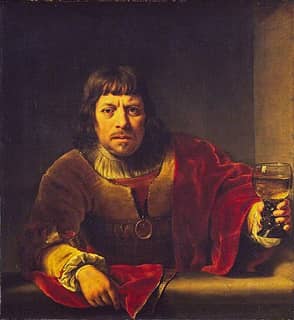
Ferdinand Bol (1616–1680) was one of Rembrandt's finest students. *The Toper* (1651), now in the Wallace Collection, shows only one man: a wide-brimmed hat, a linen collar, a goblet raised in his right hand, his left hand resting on the back of a chair, his eyes slanting over to look at you, outside the painting.
"Toper" is an old word meaning habitual drinker, someone who drinks year in and year out. But there is no drunkenness in the painting: no tilting table, no spilled wine, and his clothes are neat. He merely holds up the cup, his gaze a little off to the side.
2. The Cup
Look at the cup. It is empty.
In seventeenth-century Dutch genre painting, wine glasses, oysters, peeled lemons, and overturned clay jugs are a set of symbols pointing to the senses and to transience. But this painting handles it differently: Bol paints the goblet so thin that you can see the dark red behind it. Along the rim of the cup there is a fine, tall highlight—the brightest spot in the whole painting, brighter than the face.
This amounts to giving the light to the vessel, not to the man. The man stands in half-light, the vessel in the light; the man looks as if he is speaking, the object shines in silence. This is the Rembrandt approach, only Bol uses it with restraint.
3. That Glance
Now look at his eyes.
Figures in paintings usually do not look at the viewer. In seventeenth-century portraits, a direct gaze is reserved for almost only two kinds of people: the patron and the saint. A drunkard—by what right does he look straight at you?
Because this glance is not a salute, it is an invitation, pulling you to the table. You stand outside the painting, and he raises his cup toward you. So the frame is no longer a wall but the edge of a table. You either sit down or walk away.
This is also the cruelest thing about Dutch genre painting: it does not preach, it makes you take part, and then lets you feel embarrassed on your own.
4. Bol's Situation
Bol studied under Rembrandt for seven years, and in the 1650s he left Amsterdam for the more lucrative market of municipal commissions. He later became a notable of Amsterdam, married a wealthy widow in 1653, and his style grew ever more respectable.
*The Toper* was painted while he was still making student-like explorations. You can see two tastes pulling at each other: Rembrandt's chiaroscuro and psychology, and the cleanliness and respectability the Dutch loved. What moves one in this painting is precisely that this pull has not yet ended.
5. In a Word
The most sober thing in this painting is that empty cup: it holds back everything on the man's behalf, without saying a single word.
