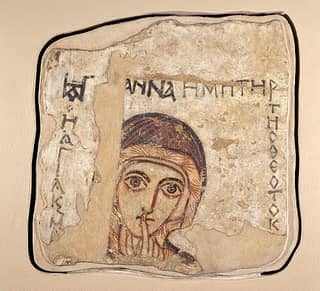
Saint Anne with only a face left: a fragment taken from the wall of the Nubian cathedral became the emblem of the National Museum in Warsaw
This is "Saint Anne" from the north wall of the nave of the Cathedral of Faras in Nubia, painted around the 8th to 9th century. The Greek inscription reads "Anna, mother of the God-bearer," that is, the mother of the Virgin Mary. The fragment entered the collection of the National Museum in Warsaw in 1964 and later became the museum's emblem.
On this palm-sized patch of plaster, only a face, a few knuckles, and two lines of Greek on the back wall remain. Yet it became the emblem of the National Museum in Warsaw.
It depicts the Nubian "Saint Anne," painted around the 8th to 9th century, with pigments applied in tempera directly onto dry plaster (al secco), not as a fresco. It was found on the north wall of the nave of Faras Cathedral, about three meters above the floor—a spot that today lies beneath the waters of Lake Nasser. From 1961, Kazimierz Michałowski led a University of Warsaw archaeological team that detached it whole from the wall as part of UNESCO's international campaign to save the monuments of Nubia. It entered the National Museum in Warsaw in 1964, accession number 234058, measuring 69 × 68.5 cm, and is now displayed in Gallery 6 of the Faras Gallery—the room reconstructed to match the interior layout of the cathedral.
The Greek reads "ANNA H MHTHP THC ΘEOΔOKOY"—Anna, mother of the Theotokos (the God-bearer, i.e., the Virgin Mary). That is the whole answer to "what does this say": it depicts Saint Anne, the mother of the Virgin. She was not originally meant to be just a face: in the complete composition, Saint Anne usually holds the young Mary, and the knuckles remaining at the bottom of the image are fragments of that group of figures. So what lies before us is not a portrait but a corner left over after a rescue detachment.
Why it is worth stopping to look: the eyes are painted oversized, the pupils very dark, and the red on the cheekbones indicated with only a very few strokes. This is the vocabulary of Nubian Christian art in its mature phase—Makuria, the vanished Christian kingdom on the upper Nile in the 8th century AD, painting its own saints with its own face, not a copy of Byzantium.