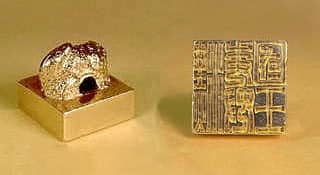
The Han seal dug from a rice paddy: the Gold Seal of the King of Na of Wa of Han
The Gold Seal of the King of Na of Wa of Han, with a snake-shaped knob. Each side measures about 2.347 cm, and it weighs 108.729 g. Unearthed in 1784 on Shikanoshima, in present-day Fukuoka, Japan. Held by the Fukuoka City Museum, it is a Japanese National Treasure. The museum's official account: this is the very seal recorded in the Book of the Later Han, bestowed by Emperor Guangwu in 57 CE upon the King of Na of Wa.
[Where the image comes from]
This image comes from the Wikimedia Commons file King_of_Na_gold_seal.jpg.
It was first uploaded by the Chinese Wikipedia user "金翅大鹏鸟" on June 30, 2005, later transferred to Commons, and in 2014 and 2023 someone cropped and retouched it.
Commons marks it as public domain, with the template PD-Art. p.jic.io also records the rights as public domain.
Note: PD-Art was originally intended for faithful reproductions of two-dimensional works. This is a photograph of a three-dimensional object, so whether this license fully applies is uncertain.
The photographer of the original photo: uncertain.
[Historical fact: the gold seal itself]
The following is based on the "Gold Seal" page on the official website of the Fukuoka City Museum.
The inscription has five characters in three lines: "Han" "Wei Nu" "King of". The museum reads it as "King of Na of Wa of Han" (かんのわのなのこくおう).
Seal face side lengths: right 2.345 cm, left 2.349 cm, average 2.347 cm. Total height 2.236 cm.
Weight 108.729 g, gold content 95.1%.
The knob is a coiled snake, with its head facing the center of the seal face. There is a hole in the knob through which a cord can be threaded.
The characters on the seal face are recessed. The museum explains: Han dynasty documents were written on wooden and bamboo slips and bound with cord. The knot was sealed with clay, and then the seal was pressed onto it. The characters came out raised on the clay.
[Historical fact: dug out of a field ditch]
According to the Fukuoka City Museum. Discovered on February 23, 1784 (the fourth year of Tenmei in Japan) on Shikanoshima, in present-day Higashi Ward, Fukuoka City.
Records say a farmer on the island dug it up by chance while repairing a ditch to channel water into the fields.
The gold seal was handed over to the authorities and appraised by Kamei Nanmei, a Confucian scholar of the Fukuoka domain.
Based on the "Biography of the Eastern Barbarians" in the Book of the Later Han, Nanmei concluded that this was the seal granted by Emperor Guangwu in 57 AD to the "King of the Na state of Wa." The museum says this remains the established interpretation of the gold seal.
The seal later passed to the Kuroda family, lords of the Fukuoka domain. It was designated a National Treasure in 1931. In 1978 the Kuroda family donated it to Fukuoka City. It is now on long-term display in the permanent exhibition hall of the Fukuoka City Museum.
According to Japanese Wikipedia: in 1954 it was redesignated a National Treasure under the Law for the Protection of Cultural Properties.
[Historical fact: the original text of the historical record]
Original text of the "Biographies of the Eastern Barbarians" in the Book of the Later Han (according to Wikisource):
"In the second year of Jianwu Zhongyuan, the Na state of Wa sent tribute and came to court to offer congratulations. Its envoy called himself a grandee, and it is at the southernmost boundary of the Wa country. Guangwu granted it a seal and cord."
The second year of Jianwu Zhongyuan is 57 AD.
[Historical fact: what the gold and the snake indicate]
The following is based on the Fukuoka City Museum.
The material of Han dynasty seals (jade, gold, silver, bronze), the shape of the knob (dragon, turtle, camel, snake), and the color of the cord indicated the status of the seal holder.
Material and cord color indicated status; knob shape indicated region and ethnicity.
A gold seal with a snake knob indicates that, in the eyes of the Eastern Han court, the "King of Na" of "Wei" was the king of a southern foreign people.
[Historical fact: a counterpart far away in Yunnan]
According to Japanese Wikipedia: the "Seal of the King of Dian," excavated from ancient tombs at Shizhaishan in Jinning, Yunnan, from 1955 onward, is also a gold seal with a snake knob.
The "Records of the Grand Historian: Biographies of the Southwestern Barbarians" records that Emperor Wu of Han granted the King of Dian a royal seal in 109 BC. The scholar Nishijima Sadao pointed out that the two seals have the same form.
[Controversy]
According to Japanese Wikipedia: since the Edo period, some have suspected the seal to be a later forgery, for example the 2006 work by Miura Sukeyuki.
The opposing side says: if a forger had followed the Book of the Later Han, they should have written "Wa" rather than "Wei"; and there were no snake-knob seals in seal catalogues of the time to copy from.
How to read "Wei Nu" has also long been debated in academia.
Whether it is authentic: the museum's established view is that it is authentic, and this article follows the museum. Final conclusion: uncertain, left to academia.
[Legend]
No separate legendary material was found for this entry. Not written.
[AI interpretation, not a conclusion from sources]
A small seal less than 2.4 cm across lay in the earth for seventeen hundred years and was dug up by a man repairing a ditch.
My understanding is: it is not just a treasure; it is like the seal on an ancient diplomatic document.
This passage is only my interpretation.
