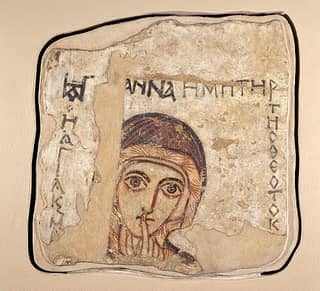
Saint Anne of Faras: a wall-painting fragment rescued before being submerged by the Nile
This is not a complete portrait, but a fragment of a fresco from the north nave of the Faras Cathedral in Makuria, dating from the 8th to 9th century: Saint Anne with her hand to her lips, without a halo. In the 1960s a Polish archaeological team detached it before the Aswan Dam flooded Nubia; since 1964 it has been held in the Faras Gallery of the National Museum in Warsaw, and it once served as the gallery's emblem.
All that remains in the image is a woman's head, shoulders, and right hand raised to her lips. She has no halo; the folds of her purple-red headscarf (maphorion) are outlined in black lines, with a pale yellow lining. Her face is elongated, her nose straight, her eyes wide open, with pale purple lower eyelids and dark purple upper eyelids. According to Kazimierz Michałowski's description, her slender right hand supports her cheek, with the index finger pressed to her lips, and the fingernail is still visible. The original painting may have been a standing or seated figure; what survives is only the upper-body fragment, measuring about 69 by 68.5 cm, executed in tempera dry fresco (al secco) on plaster, not a true fresco painted while wet.
Saint Anne does not appear in the canonical Gospels; she is the mother of the Virgin Mary in the Protoevangelium of James. This painting is estimated to date from the 8th to 9th century, from the kingdom of Makuria, at the cathedral of Faras near present-day Wadi Halfa in Sudan. It was painted on the first layer of plaster on the north nave wall, about 3 meters above the floor, and was later covered by a second layer of painting—the composition of Queen Martha. The north nave may have been used by women; the walls also feature the founder, saints, queens, martyrs, and healers, most likely for private prayer.
In the 1960s, the UNESCO Nubia campaign rescued monuments along the river before the Aswan High Dam flooded the area. A Polish archaeological team removed this painting from Faras. Since 1964 it has belonged to the National Museum in Warsaw, displayed in Room 6 of the Faras Gallery, and was once used as the museum's logo. So this image is not about an inscription, but about a Nubian Saint Anne who was covered by a later layer of wall painting and then removed in one piece before the flood came.
