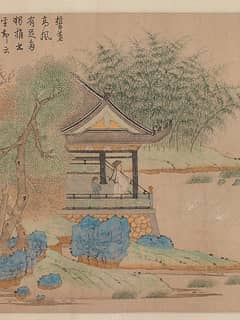
Write a scripture, trade for a flock of geese: Qian Xuan's Wang Xizhi Watching Geese
A handscroll painted around 1295 by Qian Xuan, a painter of the late Song and early Yuan dynasties, depicting the Eastern Jin calligrapher Wang Xizhi watching geese from a pavilion by the water. The story comes from the Book of Jin: Wang Xizhi wrote out a scripture for a Daoist priest of Shanyin in exchange for a flock of geese. The original painting is held at The Metropolitan Museum of Art in New York.
[Where the image comes from]
This image comes from The Met Open Access data from the Metropolitan Museum of Art in New York, accession number 1973.120.6. The Met marks this work as public domain (isPublicDomain = true), and the image is licensed under CC0, so it can be used freely. The p.jic.io image file is also marked CC0.
[Historical facts: basic information about the painting]
Title: Wang Xizhi watching geese.
Artist: Qian Xuan, courtesy name Shunju. He was from Wuxing (present-day Huzhou, Zhejiang) and was a painter of the late Song and early Yuan dynasties.
Date: The Met gives about 1295, Yuan dynasty.
Format: handscroll; ink, color, and gold on paper.
Dimensions: according to The Met's data, the painting itself is 23.2 cm high and 92.7 cm long; the entire scroll including mounting is 1063.8 cm long.
Location: The Metropolitan Museum of Art, New York. The provenance reads "From the family of Wang Jiqian; gift of The Dillon Fund, 1973."
[Historical facts: what is in the painting]
On the left side of the painting, Wang Xizhi stands in a pavilion by the water, and below the pavilion there are two white geese in the water. Bamboo and trees grow beside the pavilion. On the opposite shore there are cottages and trees, and behind them are deep blue mountains.
Qian Xuan wrote a poem of his own at the end of the scroll:
"Among the tall bamboo groves there is much refreshing feeling; in the idle pavilion, lying back with bared belly, what is on his mind? To write the Dao De and leave it to the alchemist, preserving a romantic love of geese." Signed "Qian Xuan Shunju of Wuxing."
There are three of Qian Xuan's seals: "Shunju zhi yin," "Qian Xuan zhi yin," and "Hanmo youxi."
The Qing emperor Qianlong wrote four large characters at the front of the scroll: "Shanyin yixing." In 1746 (bingyin) he added another poem. Ministers such as Liang Shizheng and Wang Youdun also wrote poems at the end of the scroll.
(The transcriptions of the poems and seal texts are based on the InscrChArt database at the University of Miami.)
[Historical facts and story: why Wang Xizhi loved geese]
Wang Xizhi was a calligrapher of the Eastern Jin, later called the "Sage of Calligraphy."
According to the "Biography of Wang Xizhi" in the Book of Jin: he loved geese by nature. In Shanyin (present-day Shaoxing, Zhejiang) a Daoist priest kept a flock of fine geese. Wang Xizhi went to see them, liked them very much, and insisted on buying them. The priest said, "If you write me a copy of the Dao De Jing, I will give you the whole flock." Wang Xizhi was delighted; when he had finished writing, he put the geese in a cage and took them home.
The line in Qian Xuan's poem, "To write the Dao De and leave it to the alchemist," refers to this story.
There is another version: that Wang Xizhi wrote the Huangting Jing. This version appears in the Jin Zhongxing Shu quoted in the Taiping Yulan, and Li Bai also wrote in a poem, "He should write the Huangting to exchange for white geese." So the histories disagree about which scripture he wrote.
[Historical facts: how researchers see it]
Met curator Shi-yee Liu published an article in volume 54 of the Metropolitan Museum Journal in 2019. She considers this painting to be by Qian Xuan's own hand; another Met scroll, Tao Yuanming's Return, is now regarded as a fine copy of Qian Xuan's original. The article says the painting uses heavy mineral green, mineral blue, and gold to depict a decorative fairyland. The village in the clouds on the opposite shore, however, is painted relatively realistically.
The article's title interprets both paintings from the angle of Qian Xuan as a Song "yimin" (leftover subject). According to English Wikipedia: after the Yuan dynasty was established, Qian Xuan did not take office and was regarded as a Song loyalist.
[Uncertainties and points to note]
1. Sources disagree on Qian Xuan's birth and death dates. The Met's object page gives 1239–1301. The 2019 article above gives born about 1235 and died before 1307. English Wikipedia gives 1235–1305. I cannot determine which is correct.
2. Ancient books disagree on whether Wang Xizhi wrote the Dao De Jing or the Huangting Jing (see above).
3. "About 1295" is The Met's dating; no year is written on the painting.
4. I read the year of Qianlong's poem and the ministers' poems from the InscrChArt transcription, and have not checked them character by character against a high-resolution image of the original scroll.
[AI interpretation]
(The following is my own view, not historical fact.) The painting is titled "Watching Geese," yet Wang Xizhi and the two geese are both very small in it; most of the picture is water and mountains. Qian Xuan did not serve as an official under the Yuan. Perhaps what he painted was not only a calligrapher who loved geese. He was also painting the life he wanted: a pavilion, a stretch of water, a few geese, and no one to disturb him.