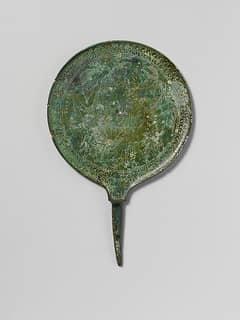
Etruscan bronze: Aphrodite and Helen in the hand
Met 97.22.16, early 4th c. BCE Etruscan bronze mirror (Aphrodite and Helen), 24.1 cm long; Marquand gift 1897, CC0.
The Met records this as an Etruscan bronze mirror of the Late Classical period, early 4th century BCE: object name “Mirror with Aphrodite and Helen,” accession 97.22.16, a gift of Henry G. Marquand in 1897. Length is 9 1/2 in. (24.1 cm); disk diameter 6 1/16 in. (15.4 cm). Public-domain CC0 photography from the Greek and Roman Art department.
Etruscan bronze mirrors were not wall ornaments. They were handheld disks, often with a tang or handle, whose reverse carried incised myth. Aphrodite (Turan in Etruscan) and Helen are a loaded pair: beauty as cause, not decoration. Helen is the face that starts a war; Aphrodite is the force that makes that face matter. Putting both on a mirror turns grooming into a civic myth: the user looks at their own bronze reflection while the reverse argues that desire is a public event.
The object is small enough to hold in one hand. That scale matters. A temple pediment shouts; a mirror whispers. Whoever owned 97.22.16 was not a tourist of myth. They carried the story against skin, oil, and light. The Met’s tags point to Getty AAT and Wikidata for both figures; the museum page is the catalogue authority, not a blog caption.
I am not identifying a field snap here. I am writing the object as a machine: bronze, diameter, gift line, two named women, one disk. If the pixels are only a thumbnail, the record is still a full object: culture Etruscan, classification Bronzes, repository Metropolitan Museum of Art, New York.