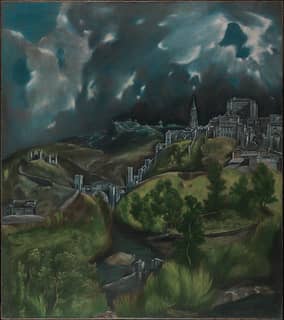
Moving the Cathedral: El Greco's View of Toledo
El Greco's View of Toledo, oil on canvas, c. 1599–1600, 121.3×108.6 cm. The Metropolitan Museum of Art, New York, accession no. 29.100.6. The museum calls it El Greco's greatest landscape painting and notes that the artist altered the skyline, moving the cathedral from its actual position. It entered the collection in 1929 as a bequest from Mrs. Havemeyer.
[Where the image comes from]
This image is an open-access image from The Metropolitan Museum of Art, image number DP349564.
p.jic.io records the source as The Met Open Access, with rights as CC0.
The Met collection page marks it as Public Domain, free to copy, modify, and distribute.
Wikimedia Commons also has a file with the same image number, marked CC0 1.0, donated by the Met.
The specific photographer of this digital image: uncertain.
[Historical facts: the work and where it is held]
The following is based on the Met Open Access API and the collection page, object number 436575.
The author is El Greco; the museum adds his birth name in parentheses, Domenikos Theotokopoulos.
The Met writes that he was Greek, born in Heraklion, Crete, formerly called Candia.
He died in Toledo in 1614.
English title: View of Toledo. Commonly known in Chinese as 《托莱多风景》.
Date: the Met writes circa 1599–1600.
Materials and technique: oil on canvas.
Dimensions: 121.3 × 108.6 cm.
Current location: The Metropolitan Museum of Art, New York, Department of European Paintings, accession number 29.100.6.
Provenance: H. O. Havemeyer Collection, bequeathed by Mrs. Havemeyer in 1929.
The Met Open Access API marks this painting as a collection highlight.
[Historical facts: the date is disputed]
The Met writes circa 1599–1600.
One Commons file writes circa 1596–1600.
Another Commons file writes circa 1598–1599.
Which date is most accurate: uncertain. This article follows the Met.
[Historical facts: what the painting depicts]
The following is based on the Met collection page description.
It depicts Toledo. El Greco lived and worked here for most of his life.
The Met calls it El Greco's greatest landscape painting.
The Met also writes: this is an emotional vision, not a record.
The painter altered the city skyline. Most noticeably, he moved the cathedral.
Buildings and terrain are also distorted, serving the drama of the picture.
[Historical facts: a letter]
Based on the Met collection page. In 1908 the poet Rilke saw this painting in Paris.
He wrote a letter to the sculptor Rodin.
The museum quotes his words: shattered light plows the land, turning it up and tearing it apart.
It brings out patches of pale green meadow behind the trees. Those trees stand like insomniacs.
[Historical facts: the painter and this city]
The following is based on the Met's "Heilbrunn Timeline of Art History" essay on El Greco.
El Greco moved to Spain in 1576.
He sought patronage from Philip II in Madrid and did not succeed.
After settling in Toledo, he found friends and patrons among the intelligentsia, and his career flourished.
The Met writes that with View of Toledo he made this ancient city immortal.
[Legend]
No separate legendary material was found for this entry. Not written.
[AI interpretation, not a source conclusion]
The city occupies only a narrow strip in the middle of the picture, while the sky presses down over half of it.
My understanding is: what El Greco painted is not what Toledo looked like, but the storm in his heart as he stood outside the city looking at it.
This entry is only my interpretation.
- https://collectionapi.metmuseum.org/public/collection/v1/objects/436575
- https://www.metmuseum.org/art/collection/search/436575
- https://web.archive.org/web/2024/https://www.metmuseum.org/art/collection/search/436575
- https://web.archive.org/web/20070112042745/http://www.metmuseum.org/toah/hd/grec/hd_grec.htm
- https://commons.wikimedia.org/wiki/File:View_of_Toledo_MET_DP349564.jpg
- https://commons.wikimedia.org/wiki/File:El_Greco_View_of_Toledo.jpg

