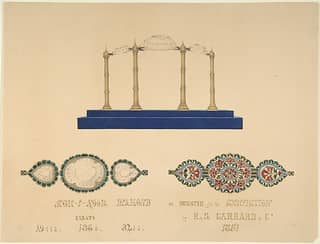
In the year of the Great Exhibition, the court jewellers drew it as it was "before the recut" — the Koh-i-Noor
The Koh-i-Noor (Mountain of Light) now weighs 105.6 carats (Historic Royal Palaces); in 1937 it was set into the crown of Queen Elizabeth the Queen Mother, and it is now displayed in the Tower of London. It is often said to come from the Golconda region of India. The 1849 Treaty of Lahore states that it was presented to Queen Victoria by Maharaja Duleep Singh (HRP). In 1852 it was recut to improve its brilliance: roughly 186 old carats → 105.6 today (GIA). This image is the 1851 watercolour by R. S. Garrard & Co. in the Met's collection (before the recut). Both the early naming and the "male curse" are marked "one account holds".
This watercolour is not the stone in the Tower of London display case — it depicts it before the recut.
In 1851, the court jewellers R. S. Garrard & Co. used watercolour and gold dust to paint the Koh-i-Noor (Persian for "Mountain of Light") exactly as you see it here: high dome, flat base, Mughal-style facets. That same year it was exhibited at the Great Exhibition in London; this Met sheet (no. 363608) depicts that "old look". A year later, it would be recut.
First, let's nail down the verifiable numbers. Historic Royal Palaces (the Crown Jewels at the Tower of London): current weight 105.6 carats; probably from mines in the Golconda region of south-central India (the original says Probably); in 1937 it was set into the Crown of Queen Elizabeth the Queen Mother, and it now belongs to the British Crown Jewels, displayed at the Tower of London. GIA usually writes 105.60 and records an oval modified brilliant cut.
How did it get to Britain? According to HRP: in 1849 the East India Company acquired the stone from the deposed Sikh ruler Maharaja Duleep Singh as a condition of the Treaty of Lahore; the treaty stipulated that it be presented to Queen Victoria. The museum calls it "a symbol of conquest". The dispute over its ownership continues to this day — this text follows only the treaty and the museum's statements, and makes no slogans.
Why is it "thinner" than it once was? HRP: it was once larger, and was recut in 1852 to improve its brilliance and suit the European taste of the time. GIA: when it arrived in Britain it was reported at about 186 old carats; Gems & Gemology 2007 records 186.1 old carats → 105.60 modern carats. Do not conflate old and modern carats. One account holds that the recut was pushed by Prince Albert and that Garrard engaged Amsterdam craftsmen to carry it out — the same Garrard line as the author of this image, which can serve as a comparison but not as sole evidence.
For the name and its earlier history, always mark "one account holds". One account: in 1739 Nader Shah exclaimed "Koh-i-noor" upon seeing the stone, and so it was named (GIA). One account: it is the same stone as the great diamond in Babur's memoirs that "supplied half the world's daily needs", or as the Mughal "Great Mughal Diamond" — scholars have debated this for a long time, and the museum does not settle it either. One account: it is unlucky for a man to wear it, so after the British royal family acquired it, it was mostly worn by queens or queen mothers — this is legend, not historical fact.
Next time you see the one at the centre of the Queen Mother's crown in the Tower of London, separate it into two layers first: the 105.6 carats in the display case, the 1937 setting, the 1849 treaty and the 1852 recut are what HRP / GIA can measure; the naming legend, the early Mughal chain, and the "male curse" are "one account holds". This image stops at 1851: the eve of the recut, the court jewellers' own manuscript.
(Image: The Metropolitan Museum of Art, "Drawing of the 'Koh-I-Noor Diamond'", R. S. Garrard & Co., 1851, watercolour and gold dust, Open Access / CC0; p.jic.io i-6403f61d051e. A sequel in the famous gemstone series; avoided: the Meat-shaped Stone, the Jadeite Cabbage, the Mao Gong Ding, Fan Kuan, the Hope Diamond, the Cullinan, the Black Prince's Ruby, the Regent Diamond.)
- HRP:105.6 ct、Golconda probably、1849 Treaty of Lahore / Duleep Singh→Victoria、1852 recut、1937 Queen Mother's Crown
- GIA 4Cs:105.60 ct、约186 old carats 抵英、1852 重切、Nader Shah 得名传说、男性佩戴传说
- GIA G&G 2007:186.1 old ct → 105.60 modern ct;1851 模具
- Met 363608:Garrard 1851 水彩;本篇 imageId i-6403f61d051e
- 同图 Commons / CC0 镜像
