Saint Anne: What the Faras Cathedral Mural Fragment Is Saying
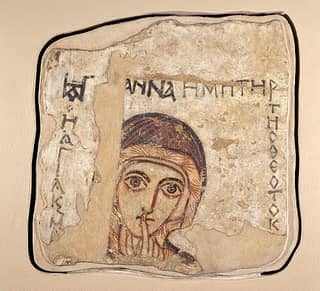
This is not a casual fragment of an Egyptian Coptic icon, but the Saint Anne mural from the Faras Cathedral in Nubia. The Greek inscription says she is the mother of the Mother of God, with her right index finger pressed to her lips.
All that remains in the image is an elongated face, a strip of purple-brown headcloth, and the index finger of the right hand pressed to the lips. The large letters on the left can be read as ΑΝΝΑ, and the fragmentary line on the right is written in a form such as Η ΜΗΤΗΡ ΤΗΣ ΘΕΟΤΟΚΟΥ, meaning "Anne, mother of the Mother of God." She is Saint Anne, the mother of the Virgin Mary. The full inscription was once read as "Saint Anne, mother of the Mother of God," but the latter half has flaked away.
This fragment comes from the great cathedral of Faras in ancient Nubia (in present-day Sudan; the site now lies beneath Lake Nasser), not from a Coptic monastery wall in the Cairo area. A Polish archaeological team removed it from the north wall of the north aisle during the UNESCO Nubian salvage campaign in the 1960s. It was painted on an earlier layer of plaster and was later covered by the mural of Queen Marta, which is why it survives today. It is now in the Faras Gallery of the National Museum in Warsaw, usually recorded under inventory number 234058, and measures about 69 × 68.5 cm; it is tempera on dry plaster. It is generally dated to the 8th or early 9th century, belonging to the purple-leaning phase of early Faras painting.
The gesture of the finger to the lips is almost unique among images of Saint Anne. There are several interpretations: silent prayer, keeping silence before the mystery of the Incarnation, or an echo of the ancient Egyptian "Harpocrates gesture." The north aisle may also have been a place where women worshippers stayed; painting the mother of Mary there gave the faithful someone to sit quietly before, rather than serving as decorative inscription.