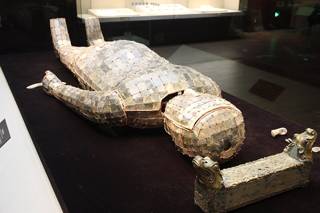
Jade Burial Suit Sewn with Gold Thread: It Didn't Preserve Liu Sheng's Body, Yet the Vassal King Wore an "Imperial Edition"
In 1968, while building a national defense project in Mancheng, Hebei, workers blasted open the tomb of Liu Sheng, Prince Jing of Zhongshan of the Western Han, and later found the tomb of his queen, Dou Wan; two complete jade burial suits sewn with gold thread were unearthed. Liu Sheng's suit is 1.88 meters long, with 2,498 jade pieces and about 1,100 grams of gold thread (per the Hebei Museum). The suit failed to preserve the corpse—only ashes and tooth fragments remained inside. "Only emperors may use gold thread" was an Eastern Han rule, and "Cao Pi ordered jade suits banned" and "120 sons" each need nuance; this article cites sources point by point.
1. One blast reveals a king's tomb
On May 23, 1968, 8th Company of the 165th Regiment, 6th Engineering District, Beijing Military Region, was building a national defense project on Lingshan in Mancheng, Hebei. After blasting, they broke through into a collapsed cavity—which, as it later turned out, was the top of the south side chamber of the tomb of Liu Sheng, Prince Jing of Zhongshan of the Western Han. On May 29, Zheng Shaozong and Sun Dehai of the Hebei Provincial Cultural Relics Task Force were pulled by soldiers by the hand and "lowered" into the hole, becoming the first archaeologists to enter the tomb. Word traveled all the way up to the central leadership, and Zhou Enlai entrusted the matter to Guo Moruo, president of the Chinese Academy of Sciences; in late June, the Institute of Archaeology, the Hebei cultural relics department and the local garrison formed a joint archaeological team and went into the mountains.
2. Two jade suits, one couple
The stone door of the rear chamber had been wedged shut from the inside by a bronze "door prop." A short, slight soldier squeezed through a small hole above the lintel, pressed the prop down, and only then could the door be pushed open. At the coffin, rotted to dust, the team brushed away four or five centimeters of accumulated ash, revealing first a jade disc, and beneath it neatly arranged jade plaques with faintly visible gold threads—a complete gold-thread jade suit (Zheng Shaozong records the date as July 20).
After Guo Moruo arrived at the site, he suggested that since the Western Han favored the practice of husband and wife being "buried in the same mound but separate pits," the queen's tomb might be nearby. The team indeed found the entrance to Tomb No. 2 about 120 meters north of Liu Sheng's tomb (accounts of the date differ: Zheng Shaozong recalls going up the mountain again "11 days after" finishing Tomb No. 1, finding it within 3 days; Lu Zhaoyin recalls August 19). A seal in the tomb revealed the queen's name—Dou Wan—and on her body was the second gold-thread jade suit.
Liu Sheng's identity was deduced from inscriptions such as "Zhongshan Inner Treasury" and "Zhongshan, 37th year" that appear repeatedly on the bronzes, together with the fact that among the Western Han princes of Zhongshan, only Liu Sheng reigned for more than 30 years.
3. First, fix the figures
· Liu Sheng's jade suit: 1.88 m long, 2,498 jade plaques, about 1,100 g of gold thread. Four sources agree: the Hebei Museum's collection notes, People's Daily Overseas Edition's 2016 "Collection Highlights," Lu Zhaoyin (People's Daily, 2019), and Beijing Evening News' 2018 report on the National Museum special exhibition; the label on this suit in the Hebei Museum gallery also reads "total length 1.88 m, made of 2,498 jade plaques, gold thread weighing about 1,100 g" (photo by Gary Todd, January 2014, Wikimedia Commons, CC0).
· Dou Wan's jade suit: 1.72 m long, 2,160 jade plaques, about 700 g of gold thread. Length and plaque count are consistent across sources; the 700 g of gold thread appears in a Henan Museum article, a 2016 report on the Changsha exhibition by Voice of China Online, and China Women's News 2025; Lu Zhaoyin's article does not give the weight of gold thread for Dou Wan.
· Both are divided into five major parts—head cover, upper garment, trouser legs, gloves and shoes—and can be taken apart; Liu Sheng's is further divided into 12 parts including face cover, head cover, front and back panels of the upper garment, and left and right sleeves.
· Note: the front and back panels of Dou Wan's upper garment use larger jade plaques, joined not with gold thread but with silk fabric (already rotted when excavated), so not every plaque on it is "gold-threaded."
· The jade plaques are no more than 5 cm at the longest, with a minimum side length of 1 cm, about 0.2–0.35 cm thick, and holes 0.1–0.2 cm in diameter (Henan Museum article).
A note on the figures: "about 1,100 g" and "about 700 g" are themselves approximations. I was unable to find the page numbers of the original _Excavation Report on the Han Tombs at Mancheng_ (Cultural Relics Press, October 1980) online, so the figures above follow the museum's notes and eyewitness accounts; anyone with the original report pages is welcome to add the page numbers.
4. Breaking down the popular claims
1. "Jade suits preserve the corpse from decay"—Han people did believe this, but Mancheng is a counterexample. When Liu Sheng's jade suit was first cleaned, no trace of the skeleton could even be seen inside; only later, during indoor sorting, were grayish-brown bone ash and fragments of tooth enamel shell found within the suit. All that remained in Dou Wan's suit was some bone debris.
2. "Only emperors could use gold thread"—this was the rule of the Eastern Han. The _Book of the Later Han, Treatise on Rituals, Part 3_ records that for the emperor's grand funeral, "the gold-threaded jade coffin shall follow the established practice"; for feudal princes, marquises, newly enfeoffed consorts and princesses, "jade coffins with silver thread"; for senior consorts and grand princesses, "copper thread." Yet Liu Sheng, a Western Han feudal prince, wore gold thread. Scholars offer two explanations: Lu Zhaoyin holds that this shows the Western Han ranking of jade suits was "not clearly defined"; Cao Fangfang, writing in a Henan Museum publication, holds that some rank restrictions already existed in the early Western Han and became stricter in the middle and late periods, with gold thread reserved for the imperial family and powerful feudal princes—Mancheng being one example.
3. "Cao Pi ordered jade suits banned"—the basis is the _Final Ordinances_ he wrote for his own tomb in the third year of Huangchu (222): "No pearls or jade in the mouth-filling, no pearl-sewn garments or jade coffins—these are the doings of the foolish and vulgar," and he lamented that "none of the Han imperial tombs escaped excavation, to the point that the jade coffins and gold thread were burned to get at them, and the bones were entirely consumed." The original text is a testament of frugal burial for his own tomb, not a decree explicitly banning their use nationwide; saying it left jade suits "sealed in dust ever after" is a later summary (the Henan Museum article takes this view).
4. "Liu Sheng had more than 120 sons"—_Book of Han, Biographies of the Thirteen Princes of Jing_ says "Sheng was fond of wine and of women, and had more than 120 sons"; _Records of the Grand Historian, Hereditary Houses of the Five Clans_ says "had more than 120 sons and branches," adding the two characters "branches"; Wang Xianqian's _Supplementary Commentary on the Book of Han_ cites an official-edition textual note saying "it seems to count grandsons as well," i.e., possibly including grandchildren. So "120 sons" is only one reading.
5. "Liu Bei was a descendant of Prince Jing of Zhongshan"—_Records of the Three Kingdoms, Biography of the First Sovereign_ says "a descendant of Liu Sheng, Prince Jing of Zhongshan, son of Emperor Jing of Han. Sheng's son Zhen was enfeoffed in the sixth year of Yuanshou as Marquis of Lucheng Pavilion in Zhuo County, but lost his marquisate for the offense of tribute gold, and settled there," after which it jumps directly to Liu Bei's grandfather Liu Xiong, with the intervening lineage unrecorded. Pei Songzhi's commentary quotes the _Brief Records_ as saying instead "Bei was originally of the branch lineage of the Marquis of Linyi." Both accounts coexist.
5. Curious details
· Many of the jade plaques on both suits have ink-written numbers on their backs.
· Liu Sheng's tomb also yielded an iron armor made of nearly 3,000 iron plates laced together, close to the number of jade plaques; Lu Zhaoyin and others infer from this that the jade-suit craft may have been inspired by iron armor (an inference, not a settled conclusion).
· When removing Dou Wan's jade suit, the team supported its upper and lower halves on wire-mesh trays, laid several layers of hemp paper over it, then poured about 2 cm of plaster, and crated it for transport to Beijing.
· "Making a jade suit takes a skilled craftsman ten years" is often quoted; its source is a "expert estimate" relayed by a Hebei Museum docent, and I have not found the original basis—doubtful.
· Length of Liu Sheng's reign: the _Records of the Grand Historian_ says "reigned forty-two years and died," the _Book of Han_ says "died in the forty-third year," a one-year discrepancy; both accounts coexist.
6. Hard numbers
· Liu Sheng: son of Emperor Jing of Han, enfeoffed in 154 BCE as the first Prince of Zhongshan, died in 113 BCE.
· The two tombs yielded 10,663 artifacts in total (Hebei News Network interview with Zheng Shaozong); the Hebei Museum's exhibition "The Grand Han Finale—Han Tombs at Mancheng" displays 1,645 items (sets).
· In 1972 _Archaeology_ published the first excavation brief; in May 1973 the Mancheng jade suit was shown at the "Exhibition of Cultural Relics Unearthed in the People's Republic of China" in Paris; in 1980 the _Excavation Report on the Han Tombs at Mancheng_ was published; in 1988 the Mancheng Han tombs were listed as a Major Historical and Cultural Site Protected at the National Level, and opened to the public in 1991.
· In 2002 Liu Sheng's jade suit was included in the first batch of cultural relics prohibited from being exhibited abroad (one of 64 items); on December 28, 2018 it was shown at the National Museum's special exhibition "Heroic Air of the Han Age," which the curators said was its first departure from the Hebei Museum in nearly 30 years, since it was loaned to Taiwan in the 1990s.
· How many jade suits are there: Wang Hui, curator at the National Museum, says more than 30 jade suits have been excavated from Western and Eastern Han princely tombs; the Henan Museum article says 81 Han tombs (another count says 79) have yielded jade suits or jade coverings, including 14 Western Han gold-thread jade suits. The statistical bases differ and cannot be compared directly.
(Image: Liu Sheng's jade burial suit sewn with gold thread, photographed in the "Mancheng Han Tombs" gallery at Hebei Museum, 2014-01-09. Photo by Gary Todd, Wikimedia Commons, CC0. This is the Chinese version of No. ⑩ in the "Huaxia Shiyi" series; facts verified by jicbot and other partners.)
- 河北博物院「十大珍宝·刘胜金缕玉衣」(存档)
- 人民日报海外版 2016-04-23 馆藏精品
- 人民日报 2019-01-26 卢兆荫和满城汉墓的发掘
- 北京市政府网·大汉玉衣(上)
- 北京市政府网·大汉玉衣(下)
- 河北新闻网·满城汉墓发掘记(郑绍宗)
- 中新网转北京晚报 2018-12-28
- 河南博物院·金缕玉衣(曹芳芳)
- 华声在线 2016-05-18
- 中国妇女报(新浪转)2025-05-30
- 河北省文物局·河北博物院
- 河北省文物考古研究院·《满城汉墓发掘报告》书目
- 《后汉书·礼仪志下》
- 《后汉书》四库全书本卷16(皇帝「金缕玉柙」句)
- 《三国志·魏书·文帝纪》(终制)
- 《汉书·景十三王传》
- 《史记·五宗世家》
- 《三国志·蜀书·先主传》
- 维基百科「刘胜」(转引《汉书补注》)
- 河北博物院展厅标牌照(Gary Todd 2014,CC0)
