The Inariyama sword: 115 gold characters found hidden in rust
An iron sword dug up in 1968 in Saitama carried a hidden gold inscription of at least 115 characters. X-rays showed it in 1978. It names King Waka Takiru, and its date is 471 or 531 AD.
The Inariyama sword: 115 gold characters found hidden in rust
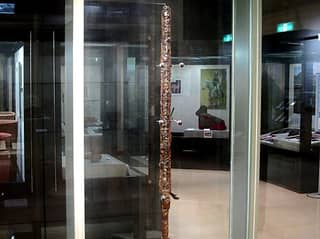
This iron sword looks plain. It hides one of the most important texts in early Japanese history. The photo shows the sword as displayed in Japan (photo by Saigen Jiro, 2013, Wikimedia Commons).
Find: Workers excavated the sword in 1968 at the Inariyama Kofun, a large burial mound in Saitama Prefecture. In 1978, X-ray analysis showed a gold-inlaid inscription of at least 115 Chinese characters. Scholars called it the discovery of the century for the study of ancient Japanese history (Wikipedia, Inariyama Sword).
Text: The inscription is in classical Chinese. It also uses Chinese characters to spell Japanese names by sound. One name is King Waka Takiru, who is thought to be Ōhatsuse-wakatakeru, an alias of Emperor Yūryaku in the Nihon Shoki. The same name seems to appear on another inscribed sword, the Eta Funayama sword (Wikipedia).
Date: The text names a year called xin-hai in the Chinese sixty-year cycle. Many scholars in Japan read it as 471 AD. Christopher Seeley suggests 531 is more likely. So the year is not settled (Wikipedia, citing Seeley 1991).
Person: The man buried in the tomb is named Wowake. He was an influential warrior in the region. The text also lists his distant ancestor, thought to be Prince Ōhiko (Wikipedia).
Metal: Japanese research suggests the iron came from copper-bearing magnetite from the Jiangnan region of China, brought to Japan, then forged into the sword (Wikipedia). This is a hypothesis of that research, not proof.
Today: The sword is a national treasure of Japan. It is on display in the Saitama Prefectural Museum of the Sakitama Ancient Burial Mounds (Wikipedia).
Image rights: public domain, per the Wikimedia Commons record linked below (p.jic.io image record i-fa7314fcc672).
