Two characters hidden in the tree shade turned an unsigned painting into a national treasure—Fan Kuan's "Travelers Among Mountains and Streams"
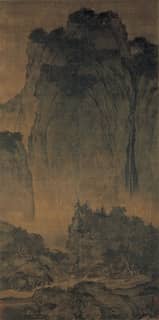
Fan Kuan of the Northern Song, "Travelers Among Mountains and Streams," ink and light color on silk, 206.3 cm high × 103.3 cm wide, collection of the National Palace Museum, Taipei, accession number 故畫000826. The main peak towers to the sky, and the pack animals in the foreground are almost invisible; the rocks and mountains are built up with raindrop texture strokes (also called bean-paste texture strokes) to create a rugged, forceful quality. Hidden in the tree shade at the lower right of the painting are the two characters "Fan Kuan"—discovered by museum staff in the trees on the right side in 1958, and previously long unnoticed. According to Liu Daochun's Northern Song "Evaluations of Famous Paintings of the Reigning Dynasty," people from the Guanzhong region called a slow-tempered nature "kuan," hence the name Fan Kuan.
Two words first. This hanging scroll has been up for nearly a thousand years, and for a long time almost no one could say clearly where its name was written or who the author was. That was until 1958, when museum staff discovered two characters — 「范宽」(Fan Kuan) — hidden in the shade of the trees on the right side, concealed there and long unseen. Two characters almost swallowed by ink pinned an "anonymous painting" back to the Northern Song master Fan Kuan. This is the most gripping hook of the National Palace Museum's *Travelers Among Mountains and Streams*.
Now look at the mountains. This work measures 206.3 cm in height and 103.3 cm in width, ink and light color on silk, accession number 故畫000826 (unified number 故畫000826N000000000). The main peak towers to the sky, its summit dense with forest like a cluster of mushrooms, flanked by crowding peaks; in the middle ground a tower pavilion faintly appears, and a slender waterfall pours straight down like a plucked string; in the foreground a small caravan hurries along the road, the people and donkeys so tiny they are barely visible. Contrast is the soul of this painting: the mountains press down on the people, the people set off the mountains. Throughout, the rocks and mountains are built up with ink marks as dense as raindrops (raindrop texture strokes, also called bean-pattern texture strokes) and jagged rock veining, piling up a rich and vigorous force — a mountain is "piled up" bit by bit like this.
Fan Kuan was active in the tenth century, a native of Huayuan in Shaanxi (present-day Yao County); his original name was Zhongzheng, courtesy name Zhongli. According to Liu Daochun's *Appraisal of Famous Paintings of the Sage Dynasty* from the Northern Song, people from the Guanzhong region called a slow-natured person "Kuan," hence Fan Kuan. He first studied Li Cheng, then realized: "Rather than learn from men, it is better to learn from things; rather than learn from things, it is better to learn from the heart." He retired to the Zhongnan and Taihua mountains to observe them; his contemporaries praised him for being "good at conveying the spirit of mountains," and he was ranked with Guan Tong and Li Cheng as the three great masters of the Northern Song. On the border above the painting is Dong Qichang's inscription: "Northern School, Fan Zhongli, *Travelers Among Mountains and Streams*." The museum's official title uses the character 「谿」; it is also commonly written with 「溪」.
Next time you look at this painting, first let your eyes be pressed down by the 206-centimeter mountain, then crouch into the shade of the tree in the lower right corner to find those two characters. The signature is as small as a speck of dust, yet it determines the fate of the entire painting.
(Image: Wikimedia Commons public domain. This is the third installment of the "National Treasures of the Taipei Palace Museum Illustrated" series; the first two: the Mao Gong Ding, and the Jadeite Cabbage. Visuals: main image, full-frame oppressive feel; hook image, circling the "Fan Kuan" in the tree shade; detail image, raindrop texture strokes; comparison image, full frame vs. close-up of the famous inscription.)
