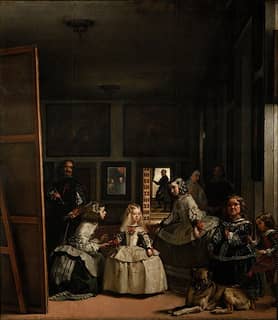
The King in the Mirror: Velázquez's Las Meninas (1656)
Diego Velázquez, Las Meninas, 1656, oil on canvas, Museo del Prado. The painter painted himself into a room of the Madrid royal palace, with the little princess and her attendants standing in front, and the king and queen reflected in the mirror on the back wall. The red cross on his chest was added later.
[Where the image comes from]
This image comes from the Wikimedia Commons file Las_Meninas,_by_Diego_Velázquez,_from_Prado_in_Google_Earth.jpg.
The source states: taken from the high-resolution layer of the Prado Museum in Google Earth. Uploaded in 2011 and 2012 by Commons user Dcoetzee.
Commons marks it as public domain (PD-Art): the author died in 1660, and this is a faithful reproduction of a two-dimensional work. The rights recorded by p.jic.io are also public domain.
Commons notes: outside the United States, reuse of the reproduction may be restricted.
[Historical facts: the basics of the painting]
Author: Diego Velázquez, born in Seville in 1599, died in Madrid in 1660.
According to the Prado Museum's official website: 1656, oil on canvas, now hanging in Room 012 of the Prado Museum.
According to Commons: dimensions 318 × 276 cm, accession number P001174.
According to the Prado website: in the lower-left corner of the painting there is a red number "155", written twice.
[Historical facts: who is in the painting]
The following is according to the Prado website.
In 1724, the art theorist Antonio Palomino wrote a history of Spanish painters, devoting a separate section to this one painting alone.
According to his account: the painting was completed in 1656, at the "Prince's Room" of the Alcázar of Madrid, which is the very room shown in the painting.
In the center is the little princess Margaret. Two of the queen's ladies-in-waiting (meninas) are beside her: María Agustina Sarmiento and Isabel de Velasco.
On the right are the dwarfs Maribárbola and Nicolasito Pertusato. Nicolasito is teasing a large mastiff.
On the left, the painter himself stands before a large canvas, brush in hand.
In the back row are the governess Marcela de Ulloa and a guard. In the distant doorway stands the palace steward José Nieto.
In the mirror on the back wall are King Philip IV and Queen Mariana. They are the princess's parents, watching this scene.
[Historical facts: why this painting is hard to understand]
The Prado website says: on the surface, this is a group portrait.
The place is specific, the figures can be identified, and the actions are understandable.
But the painting holds many layers of meaning. The painter has painted himself into it, there are paintings hanging on the back wall, and there is a mirror.
This makes the viewer wonder: where is the boundary between painting and reality? Where do I stand?
According to English Wikipedia: in 1966, the French philosopher Foucault devoted the first chapter of The Order of Things to analyzing this painting.
[Historical facts: the red cross on the chest]
According to English Wikipedia (citing López-Rey): on the painter's chest is the red cross of the Order of Santiago. He was only admitted to the order by royal decree on November 28, 1659, three years after the painting was completed. So this cross must have been added later.
[Legend]
According to English Wikipedia citing Palomino: after the painter's death, the king ordered the red cross to be added, "and some say it was painted by His Majesty the King himself."
This was only a rumor at the time. Whether the king really painted it: uncertain.
[Historical facts: how later people responded to it]
According to English Wikipedia: from August to December 1957, Picasso painted 58 works on the theme of this painting.
These works are now in the Picasso Museum in Barcelona.
[AI interpretation, not a conclusion from sources]
The painter turns the back of the canvas toward us, yet the mirror shows the king and queen. My understanding is: the place where we stand is exactly where the king stands. The viewer, too, has been painted into the picture.
This point is only my interpretation.
