Wanderer above the Sea of Fog (c. 1818): Friedrich's man on the rock
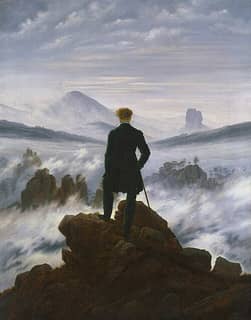
Caspar David Friedrich painted this view of a man seen from behind above a sea of fog in 1818. It mixes real Elbe Sandstone Mountain rocks, rearranged in the studio, and hangs in Hamburg.
A man in a dark green overcoat stands on a rocky ledge with his back to us. He holds a walking stick in his right hand. Wind lifts his hair. Before him a thick sea of fog fills the land, and ridges, trees and far mountains rise out of it (Wikipedia).
Origin: Caspar David Friedrich painted it in 1818, oil on canvas, 94.8 by 74.8 cm. Some sources give 1817, so the year is not fully settled (Wikipedia). It hangs in the Hamburger Kunsthalle in Hamburg. The 19th-century history of the painting is unclear. By 1939 it was in the Wilhelm August Luz gallery in Berlin, and the Kunsthalle bought it in 1970 (Wikipedia).
Place: The scene is not one real view. Friedrich sketched in the field, then rearranged the parts in his studio. The elements come from the Elbe Sandstone Mountains in Saxony and Bohemia. The Zirkelstein is in the background on the right. The rocks under the man are a group on the Kaiserkrone (Wikipedia).
Who is the man? His identity is uncertain. Some people suggest a self-portrait, because of the red hair. This is why the work is often read as a picture of self-reflection or of life's path (Wikipedia).
In his own words, Friedrich wrote: "The artist should paint not only what he has in front of him but also what he sees inside himself." On mist he wrote: "When a region cloaks itself in mist, it appears larger and more sublime, elevating the imagination, and rousing the expectations like a veiled girl." (both quoted in Wikipedia).
Fame came late. Wikipedia says the work was not at once seen as a masterpiece. Friedrich's reputation grew in the early 20th century, and more from the 1970s. The Rückenfigur, a figure seen from behind, is a favourite device of his, and this is perhaps the most famous one in art.
Image rights: public domain, the artist died in 1840 (Wikimedia Commons file record).
