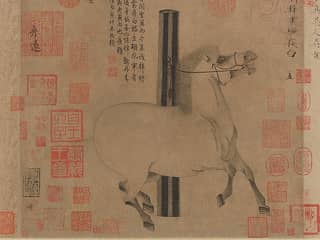
An Unbridled Imperial Horse: Han Gan's "Night-Shining White" and a Thousand Years of Inscriptions and Seals Upon It
"Night-Shining White" in the collection of The Metropolitan Museum of Art depicts Emperor Xuanzong of Tang's imperial horse "Night-Shining White" and is attributed to Han Gan. The painted core measures only about a foot square, yet it has been filled with inscriptions and seals by collectors across the ages—Li Yu, Mi Fu, the Qianlong Emperor and others—and mounted into a handscroll over eleven meters long. This piece discusses the image, the painter Han Gan and his teacher Cao Ba, the inscriptions and seals, and how it left Beiping around 1936 and entered the Met in 1977, noting which points remain disputed.
【First, look at the painting】
The painted surface measures about 30.8 × 34 cm, ink on paper. A horse is tethered to a wooden post, head held high, eyes wide, nostrils flared, all four hooves springing up, as if about to snap the reins. The Metropolitan Museum of Art (Met) reads it this way: this spirited horse is a miniature of the legendary "heavenly horses" of the Western Regions (descendants of the sweat-blooded steeds, incarnations of dragons). The technique is what Tang people called "white painting": ink lines with pale ink washes, no color.
It is not complete. According to the "Han Gan" entry in the Berkshire Dictionary of Chinese Biography, the present painting is missing the horse's tail, and there are traces of later retouching around the hind hooves and the bridle; whether the horse is "dancing" or struggling, that entry considers impossible to know for certain; the entry also cites the scholar Robert Harrist's conjecture that this may be a preparatory sketch for some lost major work.
【Whose horse is it】
"Night-Shining White" was Emperor Xuanzong of Tang's imperial horse. Zhang Yanyuan's Record of Famous Paintings Through the Ages (Lidai Minghua Ji) of the Tang says: Xuanzong loved big horses, and the imperial stables held as many as four hundred thousand; "he then ordered all their fine steeds painted, among them Jade Flower Steed (Yuhua Cong) and Night-Shining White."
【The painter Han Gan and his teacher Cao Ba】
The same book records that Han Gan was from Daliang; Wang Wei saw his paintings and praised him, and he rose to the office of Vice Director of the Court of the Imperial Treasury (Taifu Si Cheng), being especially skilled at saddled horses: "he first studied under Cao Ba, and later excelled on his own." Cao Ba was a famous master summoned by imperial decree to paint the imperial horses. Du Fu's "Painting in Green and Blue, Presented to General Cao Ba" writes: "His disciple Han Gan early entered the inner room, and could also paint horses to the utmost of their strange forms. Gan paints only flesh, not bone; how he lets the noble steeds' spirit wither away." Du Fu thought the disciple's horses too fat; Zhang Yanyuan disagreed, saying Du Fu "hardly understood painting." There is another anecdote, cited in the Taiping Guangji from the Tang work Tang Hua Duan: Xuanzong told Han Gan to take Chen Hong as his model, and Han Gan replied: "I have my own teacher—the horses in Your Majesty's inner stables are all my teachers." This comes from notebook records and may not be a factual account.
It should be noted: there is no signature of Han Gan on the painting. The Met's Chinese page lists the artist as "attributed to Han Gan," and points out that the horse's contours and proportions actually follow earlier traditional painting methods.
【A thousand years of inscriptions and seals】
This small painting was inscribed and sealed layer upon layer by later generations; the entire mounted scroll is about 11.4 meters long. The six characters "Han Gan painted Night-Shining White" are the title inscription of Li Yu, the last ruler of the Southern Tang, with his cipher; Wu Yue of the Southern Song wrote beside it that anything bearing a Southern Tang cipher is mostly genuine—this was his connoisseurial opinion. The painting also bears the two characters "Yanyuan," said to have been inscribed by Zhang Yanyuan; Mi Fu left a single character "Fu" and the seal "Lifelong True Appreciation." The Qianlong Emperor wrote poems and colophons in the winter of 1746 (the second month of the bingyin year) and again in the spring of 1747, among them the line "Night-Shining White is truly night-shining white, yet like pear blossoms opening in the moonlit hall."
【How it came to New York】
During the Republican era, the painting was in the hands of Pu Ru (Pu Xinyu), a descendant of the Qing imperial house and a painter. Zhang Boju recalls in his essay "Lu Shilheng's Pingfu Tie": in the year before the Marco Polo Bridge Incident, he heard in Shanghai that Pu Xinyu's Night-Shining White had been bought by a Shanghai antiquities dealer named Ye, and he urgently wrote to Song Zheyuan, who governed Beiping, asking him to investigate and "not let it leave the country"; by the time the reply arrived, the painting had already been taken away by Ye and "resold to an English merchant." Zhuang Yan records in Predestined by a Former Life for the Palace Museum that the painting was sold to the British collector Sir Percival David. In 1977, the Metropolitan Museum of Art acquired it with funds from The Dillon Fund, accession number 1977.78; the museum's record is "purchase," not the commonly said "donation." Earlier details of its handling vary in the accounts and are omitted here.
Image source and license: The Metropolitan Museum of Art, Night-Shining White (1977.78), https://www.metmuseum.org/art/collection/search/39901 , CC0 (Met Open Access).
- 图片来源与授权:大都会艺术博物馆藏品页,CC0(Met Open Access)。尺寸30.8×34 cm、装裱全长11.4 m、纸本水墨、约750年、Purchase, The Dillon Fund Gift, 1977、1977.78
- Met 中文页:“据传画家为韩干”,马的轮廓与比例承袭前人传统
- Met 2008 展览说明:玄宗宠爱的战马;“白画”(baihua)指带墨晕的单色画
- 张彦远《历代名画记》卷九:韩幹大梁人、王维推奖、太府寺丞、初师曹霸;玄宗命图玉花骢、照夜白;驳杜甫“画肉”之说
- 杜甫《丹青引赠曹将军霸》原文:“弟子韩幹早入室……幹惟画肉不画骨”
- 《太平广记》卷212引《唐画断》:“陛下内厩马,皆臣之师也”
- 《伯克希尔中国传记辞典》韩幹条:缺马尾、后蹄与笼头有补笔;李煜题签与吴说按语(引 Hearn 2008);曾属大卫德收藏,1977年入藏 Met
- 迈阿密大学 InscrChArt 题跋整理:李煜押字题签、“彦远”、米芾“芾”与“平生真赏”印、乾隆1746/1747年题诗跋原文
- 北京晚报靳飞文,引张伯驹《陆士衡平复帖》(卢沟桥事变前一年、沪估叶某、宋哲元、转售英商)及庄严《前生造定故宫缘》(卖给大卫德爵士)