In the summer of 1951, there was still no overall plan for the reserve force barracks.
This set of GHQ Civil Affairs Section engineer records at the Library of Congress is not a planning outcome but a shelved reminder: the National Police Reserve's barracks were still being built piece by piece at emergency speed, with standards that contradicted one another.
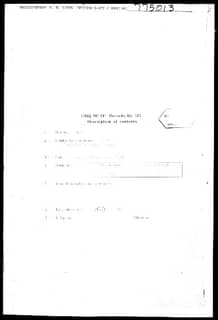
The cover is just a content description: GHQ/SCAP Records (RG 331), Box 2401, Folder (23) "Planning - Long Range", dated June to August 1951, classification number 400. The actual document begins with the Engineer Section's subject index. The index records two memoranda, both by Califf, on the subject of "long range planning of facility development." The second is dated August 14, 1951, and the typed annotation beside it is blunt: Mr. Eguchi took no action; the Construction Section chief received no relevant information.
The formal memorandum of August 14 was written by Major John W. Califf (Engineer), Engineer Section, Logistics Division, Civil Affairs Bureau, to the Director of Logistics. He refers back to the June 22 memorandum on the same subject to the Executive Officer, and states: on July 5 the Executive Officer gave a copy to Mr. Eguchi, but the Police Reserve appeared to take no action, and neither the Reserve's Construction Section chief nor the engineers at General Group Headquarters received the material. Califf's judgment is not abstract: without even a single revised master plan, avoidable problems are being created every day; without coordinated plans for each camp, it is difficult to budget construction and difficult to design buildings; the present piecemeal new construction and repairs, because the final camp standards are unknown, are neither economical nor efficient. He asks that Eguchi be approached again at once for his reaction to the original proposal. On an internal routing slip of the same day, someone asked him in pencil: What is the status of construction standards now? I thought the Reserve was working on this. And suggested he draft a planning directive to be issued by the Director, designating responsibility for long-range planning and attaching target dates.
The shelved original of June 22 is the main body of this file. Califf wrote to the Executive Officer, through the Director of Logistics: Reserve construction funds must be spent to good effect, and future facility plans must be directed at overall long-term needs, not at the one building in front of them. He acknowledges that earlier planning was fragmentary, but attributes this to emergency deployment and the need to provide shelter as quickly as possible, not to planning laziness. He says that although housing is insufficient, everyone has been given a place to live; once the 1951–52 fiscal year projects are complete, the most urgent operational facilities, such as communications and maintenance shops, will also be in place. The Reserve has been organized into combat units and can begin to consider permanent deployment. Until then, no large sums should be committed to construction.
The stages he proposes are specific. First, set construction standards in three grades—permanent, semi-permanent, and temporary—covering housing, warehouses, utilities, workshops, offices, and training facilities, specifying area allowances for sleeping, storage, recreation, training, and administration, as well as bath and latrine, lighting, heating, and cooking equipment. Structural types (concrete, wood, steel) are to be specified by climate; architectural style should not be rigidly prescribed but should be compatible with existing local buildings. Standards are to be written as maximum limits, not minimums; and a set of sketches of typical facilities should accompany them for estimating and for working up detail drawings. The standards should be approved by the highest Reserve authority, and preferably also agreed by the Ministry of Finance, the Ministry of Construction, and the Prime Minister's Office, but work should not stop while waiting for outside agreement. At the same time, classify the camps: use, capacity, and planned degree of permanence. He particularly notes that the same camp may count as temporary for one use and permanent for another, and that classifications will change with the master plan. Only then comes the general layout prepared by camp commanders with the assistance of area engineers: existing conditions, the works required to meet standards, and projects listed by priority; area commands consolidate these and send them to General Group Headquarters, which combines them into a multi-year overall priority list, and only after approval by Reserve Headquarters is it called a construction plan. The plan is not fixed; it changes with deployment, strength, organization, and funding. Separate alternative plans for expansion or reduction are to be prepared and kept out of the formal plan unless something unexpected happens. The last item is aimed at fiscal year 1952–53: start at once, the impetus must come from the top, every echelon must take part, and it must be coordinated with the Engineer Section of the Civil Affairs Bureau.
The routing slip of June 23 calls this paper a "treatise on long-range planning of facilities" and suggests rewriting it as a memorandum to superiors, to be given to a person whose handwriting looks like Manhara, as a proposal asking him to initiate systematic planning. The annotation also says the matter had been discussed several times with General Group Headquarters and Reserve Headquarters, with no visible result.
So these 11 pages are not a completed plan but the follow-up record of an engineer staff officer at the end of the occupation: the National Police Reserve had passed the stage of "first give people a roof," and still no one was willing to put the camps' final form into executable standards and master drawings.