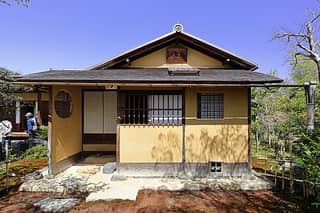
Why Jo-an in Urakuen is famous
Jo-an is a National Treasure tea house built about 1618 by Oda Urakusai and moved in 1972 into Urakuen garden beside Inuyama Castle.
The photograph is of Jo-an (如庵), the National Treasure tea house that stands in Urakuen garden at 1 Inuyama-Gomonsaki, Inuyama, Aichi, just east of Inuyama Castle. The garden’s name means Uraku’s garden. Jo-an is famous because it is one of the very few surviving tea rooms still treated as a National Treasure, commonly grouped with Tai-an and Mittan as the three great National Treasure tea seats.
It was built around 1618 by Oda Urakusai (Oda Nagamasu), younger brother of Oda Nobunaga and a disciple of Sen no Rikyū, on the grounds of Shōden-in at Kennin-ji in Kyoto. The room is a two-and-a-half-mat-plus-daisu plan. What people come to see is not size but the tricks that make a tiny room feel considered: the packed-bamboo Uraku window, a waist wall papered with old calendars, and a slanted wall with a central post. The exterior faces the gable of a kokera-bark hip-and-gable roof, with an earthen-floor eave pushed to the left and a plaque reading 如庵.
After leaving Kyoto the building passed through later owners, including a Mitsui residence and a villa at Ōiso, before Nagoya Railroad moved it to this site in 1972. Architect Horiguchi Sutemi supervised the garden so the tea house would sit as it had in Kyoto, with Inuyama Castle borrowed as a distant view. Urakuen also keeps the former Shōden-in shoin, an Important Cultural Property, plus other tea rooms such as Gen-an and Kō-an, where visitors can drink matcha. The interior of Jo-an itself is normally closed and shown only on reserved special viewings. That scarcity, plus the Oda–Rikyū lineage and the National Treasure designation, is why a small wooden hut in a castle-town garden is famous.